Small NEMT oSmall NEMT operators feel billing pain the hardest. One person often wears the dispatcher, owner, and biller hats, and a single batch of denied claims can swing a month from profit to loss. The good news: you do not need a billing department to bill like one. This guide is about getting clean, fast payment with limited staff using the right combination of NEMT billing software and operational workflows.
In-house, outsourced, or built into your platform?
Three realistic paths, each with a trade-off:
• In-house with software: Cheapest in fees, but it costs your time and depends on one person knowing the rules. Works if volume is low and your payer mix is simple.
• Outsourced billing service: A percentage of collections buys expertise and denial rework you do not have to staff. Best when denials are eating you alive or you are growing fast.
• Billing built into your dispatch platform: Trip data from your NEMT dispatch software becomes claims automatically, so a small team can bill cleanly without rekeying. Often the best balance for small fleets.
What to automate first
With limited hands, automate the steps that prevent the most lost revenue:
• Eligibility and authorization checks before the trip — they stop the denials that hurt small operators most.
• Trip-to-claim coding, so wheelchair and ambulatory runs carry the right HCPCS code without manual lookup.
• Electronic 837P submission with scrubbing, so claims do not bounce on technical errors.
• Remittance posting, so you are not reconciling payments by hand.
A connected workflow between NEMT scheduling software and billing can eliminate many of these manual steps before they become costly mistakes.
Cutting denials without a big team
Small fleets win on discipline, not headcount:
• Capture clean data at the curb: signatures, accurate times, and correct level of service.
• Work denials weekly, not “when there is time” — timely-filing limits are unforgiving.
• Track one number relentlessly: clean-claim rate. If it is climbing, your cash is healthy.
Many providers improve performance by using integrated NEMT billing and claims management tools that identify common claim issues before submission.
When to switch from in-house to a service
A few signals mean it is time to hand billing off:
• Your denial rate sits in the double digits and refilings pile up.
• Billing is done late at night because the day belongs to dispatch.
• You are adding vehicles or brokers faster than you can learn their rules.
If your business is expanding through networks such as ModivCare or MTM, keeping up with varying billing requirements becomes much more challenging without automation.
A realistic weekly billing routine for a small fleet
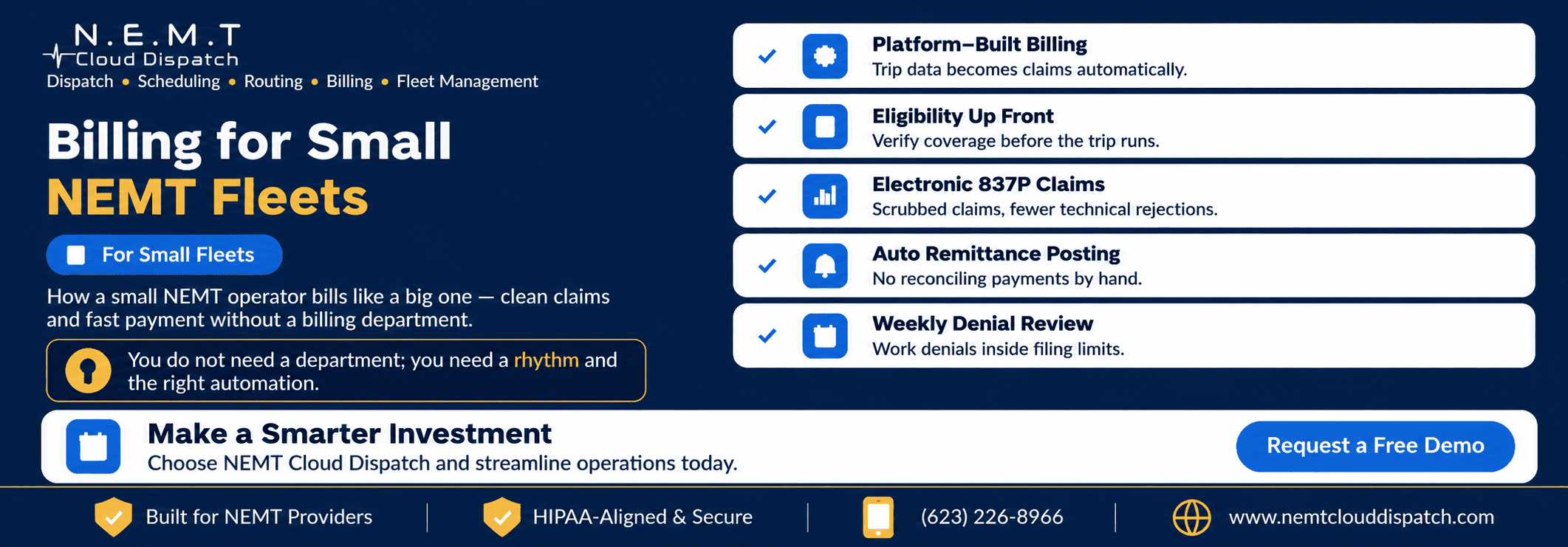
You do not need a department; you need a rhythm. A small operator can keep cash healthy with a short, fixed routine:
• Daily: Confirm every completed trip has clean data — level of service, signature, mileage — and submit claims; do not let them pile up.
• Twice a week: Post remittances and work the denial queue while the trips are still fresh and inside timely-filing windows.
• Weekly: Review clean-claim rate and days in A/R, and reconcile broker payments against what you billed.
• Monthly: Spot recurring denial reasons and fix the root cause — a driver missing signatures, a payer rule you keep tripping.
Built into a complete NEMT software platform, most of this is minutes a day rather than a second job, because the trip data is already there.
The bottom line for small operators
You do not have to choose between cheap and clean. For most small NEMT fleets, billing built into the dispatch platform — with eligibility checks up front and electronic claims out the back — delivers big-operation collection rates without a big-operation payroll.
Before choosing a solution, compare available features and review the provider’s NEMT software pricing to understand the true cost of automation versus outsourcing. Outsource the moment denials cost more than a service would.
Quick-Reference Summary
How a small NEMT fleet should set up billing
- Know your numbers: Measure your denial rate and days in A/R before deciding anything.
- Pick your model: Choose in-house software, an outsourced service, or platform-built billing based on volume and denial load.
- Automate the front end: Turn on eligibility and authorization checks first.
- Go electronic: Submit scrubbed 837P claims and auto-post remittances.
- Review weekly: Work denials and watch your clean-claim rate every week.
Frequently Asked Questions
Can a small NEMT operator bill in-house?
Yes, especially with low volume and a simple payer mix, provided you use software that automates eligibility, coding, and electronic submission. The risk is single-person dependency and denial backlog.
When does outsourcing billing make sense for a small fleet?
When denials reach double digits and go unworked, when billing is chronically late, or when you are scaling faster than you can keep up with payer rules.
What is the cheapest way to bill cleanly?
Billing built into your dispatch platform is often the best value — it removes rekeying and catches errors up front without a percentage-of-collections fee.
How do small fleets reduce denials?
Capture clean trip data at pickup, verify eligibility and authorization before the trip, submit scrubbed electronic claims, and work denials on a fixed weekly schedule.