Every billingEvery billing vendor now has “AI” on the slide deck. For NEMT providers, the useful question is narrow: does it get me paid faster and with fewer denials? Some AI in billing is genuinely earning its keep in 2026. Some is a dressed-up rules engine. This guide separates the two so you can buy on substance and choose the right NEMT billing software.
Where AI genuinely helps
A few applications are real and measurable today:
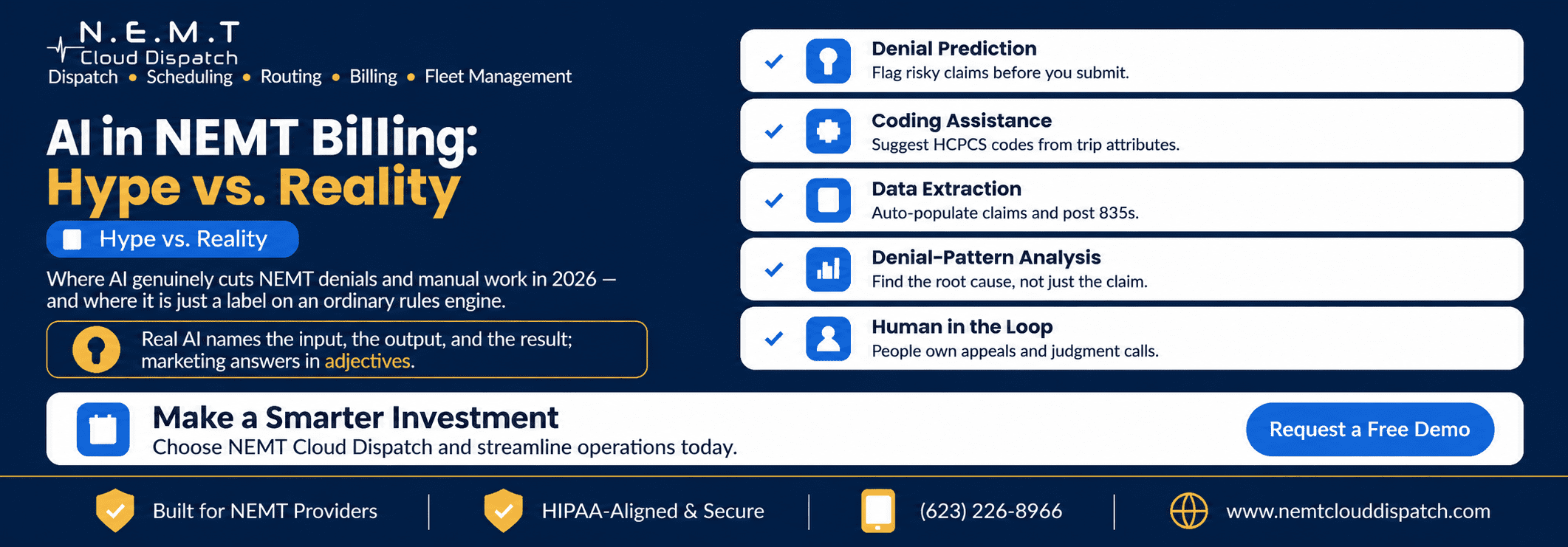
• Denial prediction: Models that flag a claim likely to be denied — wrong modifier, missing authorization, eligibility risk — before you submit it, so you fix it first.
• Coding assistance: Suggesting the correct HCPCS code and modifiers from trip attributes, cutting manual lookup errors on wheelchair vs. ambulatory runs.
• Document and data extraction: Reading trip sheets and remittances to auto-populate claims and post 835s with less manual entry.
• Denial-pattern analysis: Spotting which payers, codes, or drivers generate recurring denials so you can fix the root cause, not just the claim.
These capabilities are most effective when connected directly to your NEMT billing and claims management system, where trip records, payer rules, and claim history are already available.
Where it is mostly hype
Be skeptical when you hear these:
• “Fully autonomous billing”: Claims still need human judgment on appeals, edge cases, and payer disputes. AI assists; it does not own your revenue cycle.
• “AI guarantees zero denials”: No model eliminates denials driven by payer policy changes, missing authorizations, or eligibility lapses outside your control.
• “It replaces your biller”: The best outcomes come from AI plus a knowledgeable biller, not one without the other.
• Generic “AI” with no specifics: If a vendor cannot tell you what the model does and on what data, treat it as a buzzword.
The same rule applies whether you are evaluating AI features inside a standalone billing tool or a complete NEMT software platform.
What still needs a human
Even strong AI leaves clear work for people:
• Appeals and payer negotiation, where context and persistence matter.
• Authorization problems that require calling a broker or plan.
• Judgment on unusual trips and contract disputes.
• Oversight of the AI itself, so a bad suggestion does not become a batch of bad claims.
Even with advanced automation, providers working with networks such as ModivCare and MTM still need human oversight for exceptions, disputes, and contract-specific requirements.
How to evaluate an AI billing claim
Cut through the marketing with specific questions:
• Ask what the AI actually predicts or automates, and to see it on a real claim.
• Ask for measured results: denial-rate reduction, clean-claim lift, or hours saved.
• Ask how errors are caught and who is accountable when the model is wrong.
• Verify whether the AI works directly with your NEMT dispatch software and scheduling workflow or requires manual data transfers.
A simple buyer’s rule for AI billing claims
When a vendor says “AI,” apply one test: can they name the input, the output, and the measured result?
Real capabilities answer cleanly:
“It reads the trip record and payer rules (input), flags claims likely to be denied because of a missing modifier or authorization (output), and helps customers reduce denials by a measurable percentage (result).”
Marketing answers in adjectives — “intelligent,” “next-generation,” “fully automated” — with nothing you can verify.
If you cannot get the input, output, and result in plain language, assume the AI is a label on an ordinary rules engine and price the tool on its non-AI merits instead.
The bottom line for buyers
AI in NEMT billing is real where it prevents denials and removes manual keying, and hype where it promises to run your revenue cycle unattended.
Buy the specific, measurable capabilities — denial prediction, coding assistance, and data extraction — and keep a human in the loop for everything that requires judgment.
If you are comparing platforms, review both the feature set and the provider’s NEMT software pricing to determine whether AI-driven automation delivers a measurable return on investment.
Quick-Reference Summary
How to assess AI in an NEMT billing tool
- Define the job: Decide what you want AI to do — predict denials, assist coding, extract data.
- Demand specifics: Make the vendor explain what the model does and show it on a real claim.
- Ask for proof: Request measured denial-rate or clean-claim improvements from real customers.
- Keep a human in the loop: Confirm how suggestions are reviewed and errors caught.
- Start narrow: Pilot AI on one high-value step before trusting it across the cycle.
Frequently Asked Questions
Can AI really reduce NEMT claim denials?
Yes, where it predicts likely denials — missing authorization, wrong modifier, eligibility risk — before submission so you can correct them. It cannot eliminate denials caused by payer policy or lapsed coverage.
Will AI replace my biller?
No. AI is most effective alongside a knowledgeable biller, handling repetitive prediction and data entry while the human manages appeals, disputes, and judgment calls.
How do I tell real AI from marketing?
Ask exactly what it predicts or automates, to see it on a live claim, and for measured results from real customers. Vague “AI” with no specifics is a red flag.
Is AI billing safe for protected health information?
Only with the same safeguards as any billing tool — encryption, access controls, audit logging, and a signed BAA with the vendor providing the AI.