A will-call return becomes difficult when a rider says, “I’m ready.”
The outbound ride may have been planned hours earlier, but the return now enters a live operating day. Other riders already have pickup commitments, drivers may be delayed, and several patients can become ready within minutes.
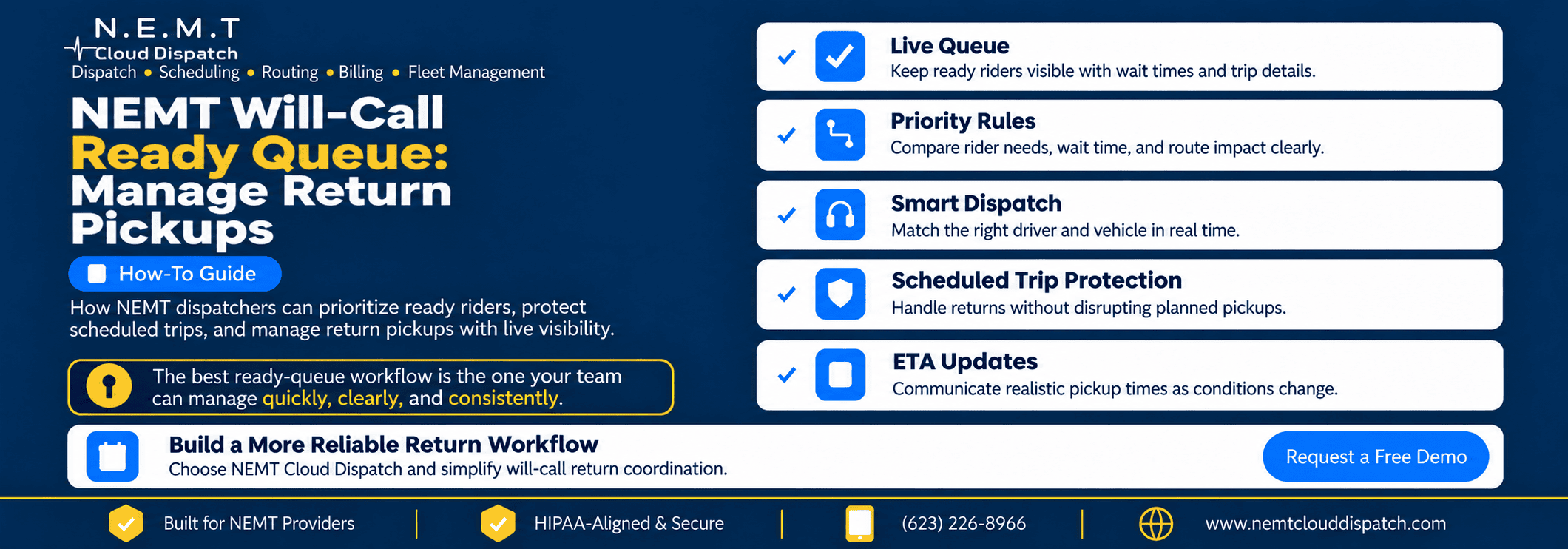
For that reason, a NEMT will-call ready queue needs a different workflow from a fixed-time schedule. Dispatch must decide which rider should move next, which vehicle is compatible, which scheduled trips must be protected, and how long each rider has already been waiting.
NEMT Cloud Dispatch brings active trips, drivers, vehicles, routing, communication, and same-day changes into one operating view.
The Workflow Starts When the Rider Is Ready
A will-call return does not have a fixed pickup time until the rider or facility confirms readiness.
For a broader explanation of will calls and when providers use them, see our guide to handling will calls in NEMT.
Once readiness is confirmed, the workflow becomes:
Confirm readiness → verify return → enter ready queue → review capacity → prioritize → assign compatible vehicle → communicate ETA → monitor pickup
This gives dispatch a repeatable way to manage live return demand.
Step 1: Make Sure the Rider Is Actually Ready
Before placing a return in the active queue, confirm:
- Rider identity
- Pickup facility or department
- Return destination
- Vehicle and mobility requirements
- Escort or attendant needs
- Broker or payer information, when applicable
- Any changes from the outbound trip
- Whether the rider is physically ready to leave
This helps prevent a vehicle from arriving while the rider is still waiting for treatment, discharge paperwork, medication, or another clinical step.
The NEMT Scheduling Software workflow keeps return-trip instructions and rider requirements connected to the trip record.
Step 2: Move the Return Into a Visible Ready Queue
The key distinction is between a rider whose return is still open-ended and a rider who is actively waiting for pickup.
A status such as Will Call — Ready gives dispatch a clear trigger.
The NEMT will-call ready queue should make active return demand visible in one place instead of burying it across phone calls, messages, notes, and dispatcher memory.
| Ready-Queue Field | Why It Matters |
|---|---|
| Ready time | Shows how long the rider has been waiting |
| Facility | Helps identify nearby returns |
| Destination | Affects route fit |
| Mobility requirement | Determines compatible vehicles |
| Driver proximity | Helps identify realistic assignments |
| Driver workload | Protects scheduled commitments |
| Vehicle capacity | Prevents assignment conflicts |
| Broker or payer context | Preserves trip-specific requirements |
The queue should help dispatch compare riders, not simply show which call came in first.
Step 3: Prioritize With Consistent Factors
When multiple riders become ready around the same time, use a consistent priority framework:
- Rider wait time
- Mobility and accessibility needs
- Compatible vehicle availability
- Driver location
- Existing scheduled pickups
- Route direction and destination fit
- Vehicle capacity
- Applicable broker or contract requirements
A strong NEMT will-call ready queue surfaces these factors without assuming that one rule can make every assignment decision.
The closest vehicle is not always the best choice. A driver five minutes away may have a scheduled pickup next, while a driver ten minutes away may complete the return without causing another delay.
Step 4: Protect Existing Scheduled Pickups
A rider who is ready now has a real need for return transportation, but that does not eliminate commitments already on the schedule.
Before assigning a return, review the driver’s current trip, upcoming pickups, travel time, mobility requirements, vehicle capacity, route direction, and expected completion time.
The NEMT Dispatch Platform provides visibility into active trips and exceptions. NEMT Routing Software supports assignment decisions using location, timing, availability, and route context.
The goal is to absorb unpredictable demand without delaying scheduled riders.
Scenario: Three Riders Become Ready Within 12 Minutes
At 1:05 p.m., a wheelchair rider finishes an appointment. At 1:11 p.m., an ambulatory rider becomes ready five miles away. At 1:17 p.m., a dialysis rider across town requests a return pickup.
Dispatch has two drivers available immediately. A third will finish a drop-off in about 20 minutes.
A weak approach assigns each return strictly in the order the calls arrived.
A stronger NEMT will-call ready queue asks:
- Which rider requires an accessible vehicle?
- How long has each rider been waiting?
- Which drivers have scheduled pickups coming up?
- Can one return fit naturally into an existing route?
- Will using the closest driver create a later conflict?
- Is the third driver a better option after the current drop-off?
The final assignment should reflect rider need, wait time, compatibility, capacity, and schedule impact.
Step 5: Assign Using the Live Operating Day
A driver who looked available in the morning may be delayed, carrying another passenger, or approaching a scheduled commitment when the rider becomes ready.
Once dispatch selects a driver and vehicle, send the pickup location, destination, rider instructions, mobility requirements, status, and relevant notes.
The NEMT Driver App gives drivers access to manifests, navigation, trip information, status updates, and communication with dispatch.
Drivers should not have to reconstruct a return from an outdated paper manifest or a short text message.
Step 6: Provide a Realistic ETA
After assignment, communicate a realistic pickup estimate to the rider or facility through the provider’s approved communication process. If conditions change, update the estimate.
For more detail on reviewing calls, notes, timestamps, and status changes, see the NEMT Trip Communication Review Workflow.
The rider, facility, dispatcher, and driver should work from the same current expectation.
Step 7: Reassess When the Assignment Stops Working
Will-call assignments can become outdated quickly. Traffic, a vehicle issue, or another exception may prevent the assigned driver from meeting the expected pickup.
The broader recovery process is covered in the NEMT Same-Day Trip Reassignment Guide.
For the NEMT will-call ready queue, the rule is straightforward: when the original plan is no longer reliable, reassess that rider against the current queue, available capacity, and scheduled commitments.
Step 8: Monitor the Queue Until Pickup
Keep every active return visible until the vehicle arrives and the rider boards.
Watch for:
- Ready riders who remain unassigned
- ETAs that slip significantly
- Drivers moving away from the pickup
- Riders who are no longer ready
- Vehicle or mobility mismatches
- Several returns accumulating at one facility
- New conflicts with scheduled trips
This turns the queue into an exception-management tool. Aging requests should be easy to identify so newer requests do not push them out of view.
Step 9: Close the Return With a Complete Trip Record
The ready-queue problem ends when the rider is picked up, but the transportation record still needs to be completed accurately.
Service times, mileage, driver, vehicle, trip statuses, notes, exceptions, signatures, and other required information should remain connected to the completed ride.
For the downstream completion process, see the NEMT Billing-Ready Trip Record.
A clean handoff helps operations, billing, and compliance teams use the same final information.
Medicaid and Real-Time Return Scheduling
Medicaid transportation programs differ by state, broker, managed care arrangement, and contract. Providers should follow the requirements that apply to their operation. For federal context, review the Medicaid Assurance of Transportation guidance.
The Federal Transit Administration also discusses real-time scheduling in demand-responsive transportation, including return trips handled on a when-needed basis. See the FTA transportation regulations and guidance.
These sources do not establish one universal workflow. Policies should reflect the applicable payer, contract, service model, and rider needs.
Frequently Asked Questions
What Is a NEMT Will-Call Ready Queue?
A NEMT will-call ready queue is a live list of riders whose return trips become active after they confirm that they are ready for pickup. It helps dispatch compare wait time, mobility needs, vehicle requirements, driver availability, route fit, and scheduled commitments.
Should Will-Call Returns Be Assigned in the Order Riders Call?
Not always. Call time matters, but dispatch may also need to consider accessibility requirements, compatible vehicles, scheduled pickups, route direction, rider wait time, and applicable contract rules.
What Should Dispatch Do When Multiple Riders Become Ready at the Same Time?
Confirm each rider, place every active return in the queue, compare wait times and requirements, review current driver and vehicle capacity, protect scheduled trips, and assign resources using a consistent framework.
Is the Closest Driver Always the Best Choice?
No. The nearest driver may have an upcoming scheduled pickup, the wrong vehicle type, insufficient capacity, or a route that makes the return a poor fit. Dispatch should consider the effect of the assignment on the full operating day.
What Happens if the Assigned Driver Is Running Late?
Reassess the return against the current queue. If another compatible driver can provide a more reliable pickup without disrupting other commitments, use the provider’s established reassignment process.
How Does NEMT Cloud Dispatch Help With Will-Call Returns?
NEMT Cloud Dispatch connects scheduling, active-trip visibility, drivers, vehicles, routing, communication, and reassignment so dispatchers can evaluate return requests using current operating conditions.
Manage the Ready Queue, Not Just the Morning Schedule
The hardest part of an unpredictable return begins after the rider becomes ready. At that point, the morning schedule alone cannot tell dispatch what to do next.
A reliable NEMT will-call ready queue turns that uncertainty into a repeatable process: confirm readiness, make the return visible, compare capacity, prioritize consistently, protect scheduled commitments, assign a compatible resource, communicate the ETA, and monitor the rider through pickup.
A well-managed NEMT will-call ready queue also helps dispatchers keep aging returns visible while protecting fixed pickup commitments elsewhere in the schedule.
NEMT Cloud Dispatch gives transportation teams the real-time scheduling, dispatch, driver, vehicle, routing, and communication visibility needed to manage that workflow without relying on memory or disconnected notes.
When the ready queue stays visible and current, dispatchers can respond to unpredictable returns without losing control of the rest of the day.
If unpredictable return pickups are creating long waits, conflicting assignments, or repeated dispatcher rework, Request a Demo and see how NEMT Cloud Dispatch can help your team manage ready riders and live trip changes from one connected system.