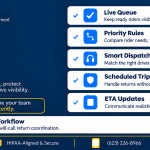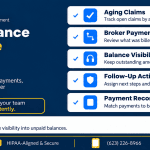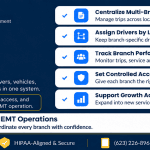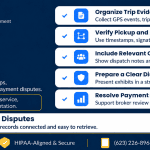
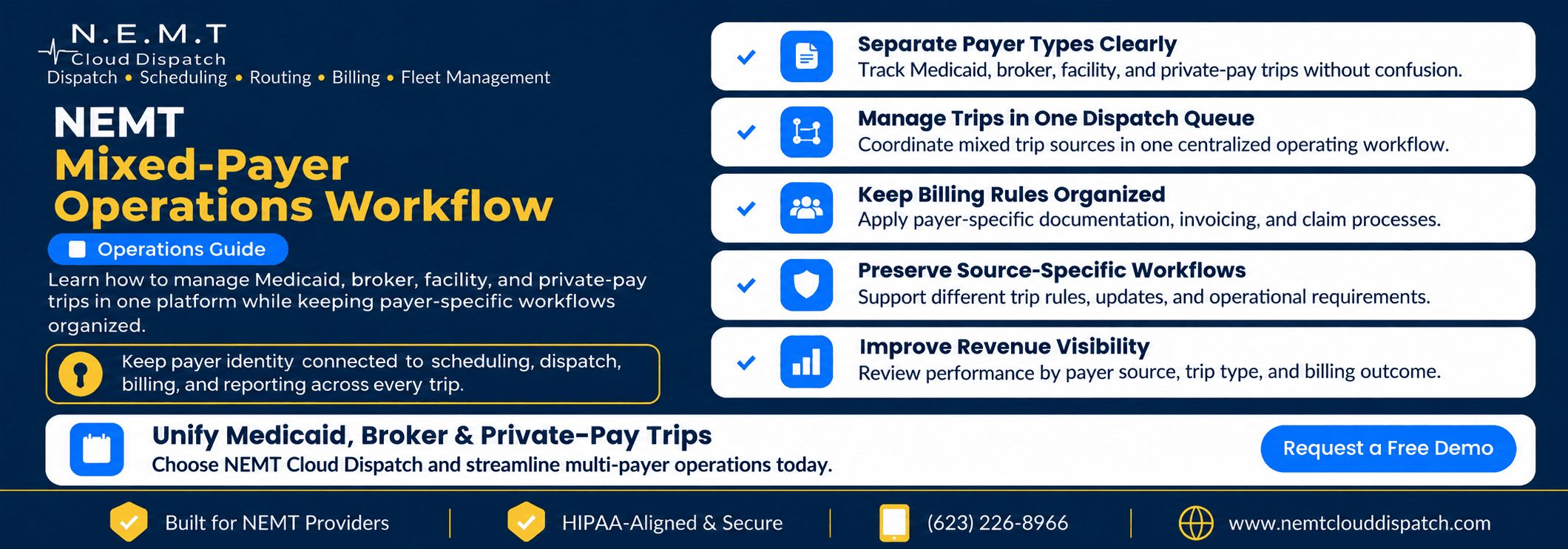
A NEMT mixed-payer operations workflow allows transportation companies to run one fleet across Medicaid-related rides, broker trips, facility work, and private-pay transportation without losing the financial identity of each trip.
That is the real challenge of a mixed-payer operation. Vehicles, drivers, dispatchers, and service areas may be shared, but downstream rules can differ. A broker trip may include a broker reference and status requirements. A Medicaid-related trip may require authorization and payer-specific documentation. A facility ride may move into contract invoicing, while a private-pay ride may require direct payment.
NEMT Cloud Dispatch supports that model by connecting scheduling, dispatch, driver activity, broker context, trip completion, invoicing, and reporting.
Why Mixed-Payer Operations Get Complicated
One driver might complete a broker trip in the morning, a facility discharge at lunchtime, and a private-pay appointment ride later that day. Operationally, those trips can use the same vehicle and dispatch board. Financially, they may move in different directions.
A strong NEMT mixed-payer dispatch software workflow makes those differences visible without requiring separate systems for every payer. A NEMT mixed-payer operations workflow keeps the operating process simple while preserving the information needed for each financial path.
States use several delivery strategies, including brokerage arrangements, to provide non-emergency transportation through Medicaid. The Medicaid Assurance of Transportation guidance provides additional program context.
Step 1: Determine the Payer or Trip Source at Intake
Every trip should enter the system with a clear source identity:
- Medicaid-related payer
- Transportation broker
- Healthcare facility
- Direct private-pay customer
- Recurring direct account
This is the first control point in a NEMT mixed-payer operations workflow.
The source can influence authorization, documentation, billing destination, reporting, and follow-up. If the source is unclear at intake, staff may have to reconstruct it later.
NEMT Cloud Dispatch’s Broker Management Software helps keep broker-specific trip activity organized while allowing dispatchers to operate across multiple sources.
Step 2: Create a Payer-Source Control Map
A payer-source control map defines what information should stay attached to the trip at each stage.
| Workflow Stage | Information That Should Stay Attached |
|---|---|
| Intake | Payer, broker, facility, customer, authorization context |
| Scheduling | Service requirements, appointment time, source identity |
| Dispatch | Driver/vehicle assignment and relevant source instructions |
| Driver execution | Trip details and required service documentation |
| Completion | Final status, mileage, timestamps, signatures, exceptions |
| Billing handoff | Correct payer, broker, facility, or direct-pay destination |
| Reporting | Trip volume, billing status, and revenue by source |
This separates a basic calendar from true NEMT mixed-payer dispatch software. The goal is not simply to view all trips together. It is to preserve the information required for the correct downstream workflow.
A NEMT mixed-payer operations workflow should keep payer identity visible from intake through reporting.
Step 3: Schedule All Trips Against the Same Fleet
A mixed-payer provider still operates one fleet. Dispatchers should be able to schedule broker, Medicaid-related, facility, recurring, and private-pay trips across the same service areas and time windows.
NEMT Scheduling Software supports future and recurring transportation planning, while the NEMT Dispatch Platform supports active trip coordination.
Within a NEMT mixed-payer operations workflow, scheduling should be driven by mobility needs, driver availability, vehicle capacity, geography, appointment time, and routing efficiency. Payer identity remains attached without requiring a second scheduling system.
Step 4: Dispatch by Service Need Without Losing Payer Identity
The core principle is:
Shared operational resources, preserved financial identity.
A broker trip and a private-pay trip may appear on the same dispatch board, but they should never become indistinguishable records.
A well-designed NEMT mixed-payer dispatch software process lets dispatchers manage the daily plan while still seeing the broker, payer, facility, or direct customer associated with each reservation.
For supported broker connections, the NEMT Broker Integrations page explains how imported broker trips can remain linked to their originating source.
Keeping that source visible is central to a NEMT mixed-payer operations workflow because it prevents downstream teams from reconstructing trip ownership later.
Step 5: Give Drivers One Consistent Execution Workflow
Drivers should not need a separate mobile process for every payer. They need pickup and drop-off details, rider instructions, mobility needs, navigation, trip status actions, and required proof of service.
The NEMT Driver App supports trip manifests, status updates, navigation, and pickup/drop-off documentation.
The office can retain payer-specific information while the driver follows one consistent workflow. That is another benefit of a NEMT mixed-payer operations workflow.
Step 6: Maintain Payer Context Through Trip Completion
A completed ride should still retain its origin.
The final record may include service date, mileage, timestamps, signatures, exceptions, and source-specific references.
The NEMT Billing-Ready Trip Record explains how completed operational details can remain connected until billing begins.
Billing staff should not need to ask whether a ride is broker-paid, facility-paid, Medicaid-related, or private-pay. In a strong NEMT mixed-payer dispatch software environment, that identity is already part of the record.
A NEMT mixed-payer operations workflow should carry that context through completion so the financial team receives a trip already associated with the correct payer path.
Step 7: Send Completed Trips to the Correct Billing Workflow
Once completed, trips may share a common operational history but branch into different financial workflows.
| Trip Source | Typical Downstream Path |
|---|---|
| Broker | Broker-specific billing or invoicing workflow |
| Medicaid-related payer | Applicable claim and authorization workflow |
| Facility contract | Facility invoicing |
| Private-pay | Direct customer payment or invoice |
The NEMT Billing and Claims Management platform supports payer-specific billing and claim workflows, while NEMT Invoicing and Billing Software supports invoicing and reporting.
This is a critical handoff in a NEMT mixed-payer operations workflow: manage the trip once, then route it to the correct financial path.
NEMT mixed-payer dispatch software should support that handoff without forcing billing staff to search outside notes or spreadsheets to determine who is responsible for payment.
Step 8: Prevent Source Mixing During the Billing Handoff
One major mixed-payer risk is a handoff error:
- A broker trip treated as direct-pay
- A facility trip sent to the wrong billing queue
- A private-pay ride missing direct-payment status
- A Medicaid-related trip missing payer or authorization context
Strong NEMT mixed-payer dispatch software reduces these errors by retaining the source until billing.
The billing team should be able to confirm trip completion, identify who is responsible for payment, and move the record into the correct process without rebuilding the reservation.
For a NEMT mixed-payer operations workflow, this source-preservation step helps reduce avoidable rework and delays.
Step 9: Keep Medicaid Context Specific
Medicaid requirements vary by state, program structure, payer, broker, and delivery model. Operators should follow the rules applicable to their state, payer arrangement, broker agreement, and contract.
The Medicaid mandatory and optional benefits resource provides federal context. Software should not replace payer policies, contracts, or state-specific instructions. Instead, it should preserve the appropriate payer, authorization, trip, and documentation context.
A NEMT mixed-payer operations workflow should keep Medicaid-related information specific to the trip without turning the entire operation into a Medicaid-only workflow.
Step 10: Separate Revenue and Performance Reporting by Payer
A company may operate one fleet, but management still needs to understand how each revenue source performs.
Useful reporting views include:
- Trip volume by source
- Completed trips by payer
- Revenue and outstanding balances
- Billing exceptions
- Cancellation and no-show patterns
- Recurring trip volume
A NEMT mixed-payer dispatch software environment should support unified operations while allowing results to be separated by payer.
A NEMT mixed-payer operations workflow becomes more useful when operational and financial views stay connected.
Step 11: Handle Exceptions Without Building Side Systems
The hardest trips are often the ones that change after booking.
A broker may cancel. A facility may add a same-day discharge. A private-pay rider may change the pickup time. A Medicaid-related ride may require an authorization review.
The change should remain linked to the original trip in a NEMT mixed-payer operations workflow so dispatch, completion, billing, and reporting continue to reference the same record.
Avoid creating a new spreadsheet, text thread, or manual list every time an exception occurs. Payer identity and billing context are most easily lost in those side systems.
Frequently Asked Questions
How Can NEMT Providers Keep Payer Types Separate While Using One Dispatch System?
Use one dispatch environment but keep the payer or source attached to every trip from intake through completion. Shared scheduling and fleet resources should not erase broker, facility, Medicaid-related, or private-pay identity.
What Trip Information Should Remain Attached When One Fleet Serves Multiple Payer Types?
Keep the payer or source, broker or facility reference, authorization context, service information, final trip status, documentation, and billing destination connected to the trip.
How Does Billing Differ for Medicaid, Broker, Facility, and Private-Pay Transportation?
The process depends on the payer and contract. The key operational requirement is to preserve source identity so each completed trip can enter the appropriate billing or invoicing workflow.
Can Dispatchers Assign Different Payer Types to the Same Fleet?
Yes. Drivers and vehicles can be assigned based on geography, service needs, capacity, scheduling, and availability while payer identity remains attached to each trip.
How Can NEMT Operators Monitor Revenue by Payer?
Maintain one broad operational view while using source-specific reporting for trip volume, completed rides, invoiced amounts, outstanding balances, and revenue.
How Does NEMT Cloud Dispatch Support Multiple Transportation Payment Sources?
NEMT Cloud Dispatch connects scheduling, dispatch, driver workflows, broker context, trip completion, billing, and reporting while preserving the source of each trip.
One Operation, Multiple Payers, Clear Financial Paths
A mixed-payer transportation company should not need a different operating system for every revenue source.
The better model is one fleet, one scheduling process, and one connected trip record with payer identity preserved from booking through billing.
That is the purpose of a NEMT mixed-payer operations workflow.
NEMT Cloud Dispatch helps operators manage broker trips, Medicaid-related transportation, facility work, recurring rides, and private-pay transportation while retaining the source-specific information needed after completion.
A connected NEMT mixed-payer dispatch software strategy supports a NEMT mixed-payer operations workflow with cleaner dispatch-to-finance handoffs, fewer source-mixing errors, and clearer payer reporting.
If your team is ready to replace disconnected trip lists, billing workarounds, and payer-specific side systems, Request a Demo and see how NEMT Cloud Dispatch can help manage mixed-payer transportation in one connected platform.