Billing software is only as good as the systems it can talk to. An NEMT claim has to travel from your NEMT dispatch board, through a clearinghouse, into a broker portal or state Medicaid system, and back again as a remittance. Every break in that chain is a place where money stalls. This guide covers the integrations that keep NEMT billing software flowing in 2026.
Dispatch-to-billing: the integration that matters most
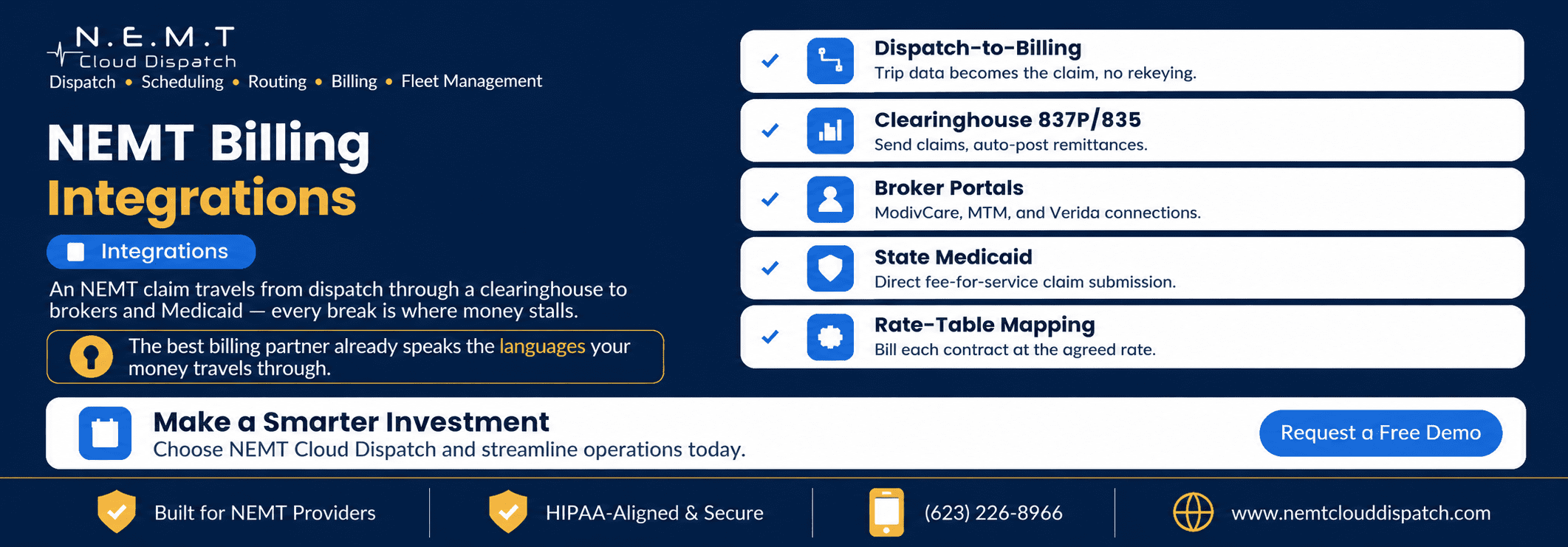
The highest-value connection is the one inside your own four walls. When dispatch and scheduling feed billing directly, the trip data you already captured — times, GPS mileage, level of service, authorization number — becomes the claim. No rekeying, no chasing drivers, no transcription errors. If billing and dispatch are separate systems, this is the first integration to insist on.
Clearinghouse connectivity: EDI 837P and 835
A clearinghouse is the post office for electronic claims. Your billing system sends claims out as EDI 837P files and receives remittance advice back as 835 files. Strong NEMT billing and claims management adds front-end scrubbing that rejects bad claims before they reach a payer, and automated 835 posting so payments reconcile themselves. Confirm which clearinghouses a vendor supports and whether transaction fees are bundled or passed through.
Broker portals and managed care
Much NEMT work flows through brokers and managed care organizations, each with its own system, rates, and rules:
• Broker platforms: Connections to networks such as ModivCare, MTM, and Verida to pull assigned trips and push claims back.
• MCO connections: Managed care plans with plan-specific codes, modifiers, and authorization rules.
• Rate-table mapping: Per-contract pricing so each trip is billed at the agreed rate automatically.
For providers working with multiple payers, a dedicated NEMT broker integrations workflow is important because broker rules, portals, trip imports, and billing formats can vary from contract to contract.
State Medicaid and eligibility
Fee-for-service Medicaid trips are billed directly to the state, and every trip should be checked against current coverage:
• Medicaid portal/EDI submission: Claims sent through the state system or its designated clearinghouse.
• Real-time eligibility: 270/271 coverage checks before dispatch to avoid unbillable trips.
• Prior-authorization lookups: Confirm and store auth numbers tied to the trip.
This is where connected NEMT scheduling software matters. Eligibility, appointment details, pickup information, drop-off details, and authorization data should be captured before the ride is completed.
Accounting and reporting hand-offs
Once money is collected, it should land cleanly in your books:
• Accounting export: Posted payments and adjustments flowing to your general ledger or accounting software.
• Custom reporting feeds: Revenue-cycle KPIs available to your finance team without manual exports.
The best setup connects dispatch, billing, reporting, and accounting so your team can track completed trips, submitted claims, denied claims, paid claims, and outstanding revenue from one workflow.
What to verify before you buy
Integrations fail quietly, so test them deliberately:
• Confirm the specific brokers, MCOs, clearinghouses, and state systems a vendor already connects to — not “can be built.”
• Ask whether connections are real-time or batch, and how failures are surfaced.
• Require signed BAAs with every integration partner that touches PHI.
• Review the vendor’s NEMT software pricing so you understand whether billing, broker integrations, support, and customization are included or charged separately.
Why integrations break — and how to spot the fragile ones
Most billing problems trace back to a connection that looked fine in the sales call and failed in production. The common failure modes are predictable:
• Batch instead of real-time: Eligibility or trip pulls that run overnight mean you only learn about a coverage problem after the trip has run.
• One-way connections: A link that pulls trips from a broker but cannot push claims back leaves you keying claims by hand anyway.
• Unmonitored failures: If a rejected 837P or a missing 835 does not raise an alert, claims silently disappear until month-end.
• “Custom build” promises: An integration that does not exist yet is a project, not a feature — and projects slip.
Ask to see each integration running on live data, confirm it is two-way, and confirm failures are surfaced the same day, not discovered in a reconciliation weeks later.
The bottom line for buyers
The best NEMT billing service is the one that already speaks the languages your money travels through — your dispatch data, your clearinghouse, your brokers, and your state Medicaid program. Map your payer and system landscape first, then choose the billing partner that connects to it out of the box.
If your operation needs connected dispatch, routing, driver communication, broker workflows, and billing in one place, explore NEMT Cloud Dispatch or review the platform’s invoicing and billing software.
Quick-Reference Summary
How to evaluate NEMT billing integrations
- Map your landscape: List your dispatch system, clearinghouse, every broker and MCO, and your state Medicaid program.
- Confirm live connections: Ask which integrations already exist versus which would need to be built.
- Test the round trip: Send a claim out as 837P and confirm the 835 remittance posts back automatically.
- Check rate mapping: Verify per-broker and per-contract rate tables bill each trip correctly.
- Lock down compliance: Get BAAs in place with every partner that handles PHI.
Frequently Asked Questions
What is the most important billing integration for an NEMT provider?
The connection between dispatch and billing. When trip data flows straight into claims, you eliminate the rekeying and missing-documentation errors that cause most denials.
What are EDI 837P and 835 files?
The 837P is the electronic professional claim you send to a payer; the 835 is the electronic remittance advice that comes back explaining what was paid. Clearinghouse integration handles both.
Can billing connect to brokers like ModivCare or MTM?
Mature billing platforms integrate with major broker networks to pull assigned trips and submit claims, with per-broker rate tables so trips bill at the agreed rate.
How is eligibility checked automatically?
Through real-time 270/271 transactions against Medicaid or the plan, ideally before dispatch, so unbillable trips are caught up front.