Every transportation vendor now markets artificial intelligence, and it is genuinely hard to tell where AI delivers real value and where it is a label slapped on ordinary automation. For a district leader spending public money, separating the substance from the slogan matters.
This guide takes an even-handed look at AI in school transportation software in 2026: what it actually does well today, where the marketing outruns the technology, and how to pressure-test an AI claim before it influences your buying decision.
Where AI genuinely helps today
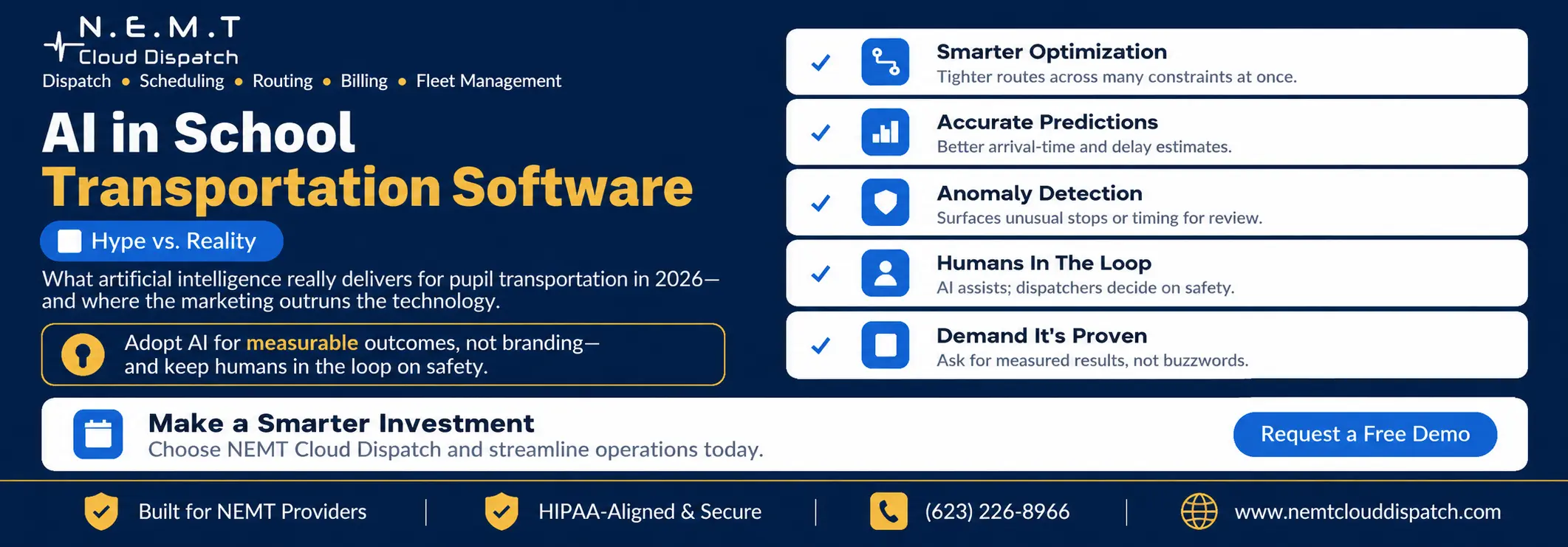
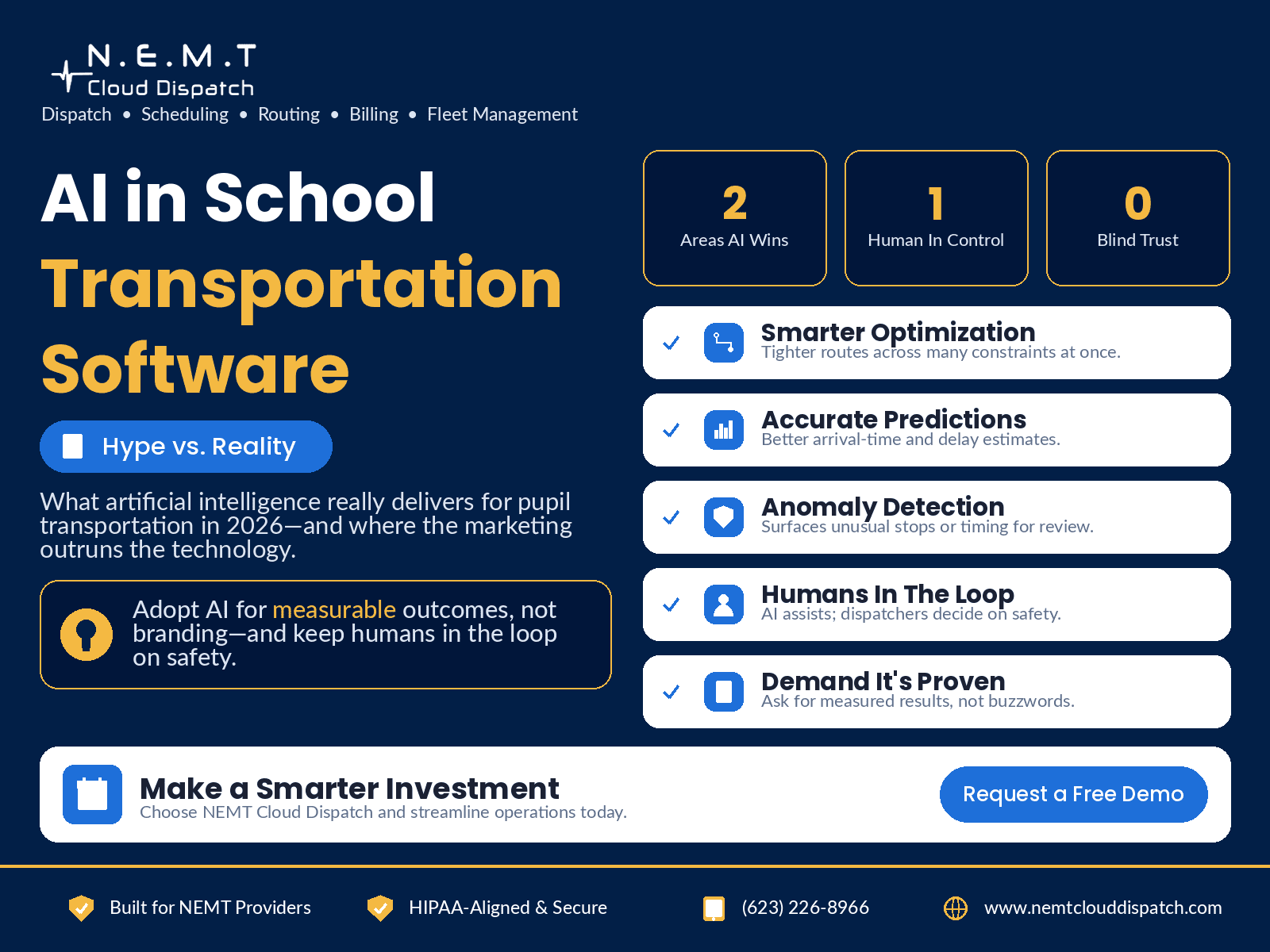
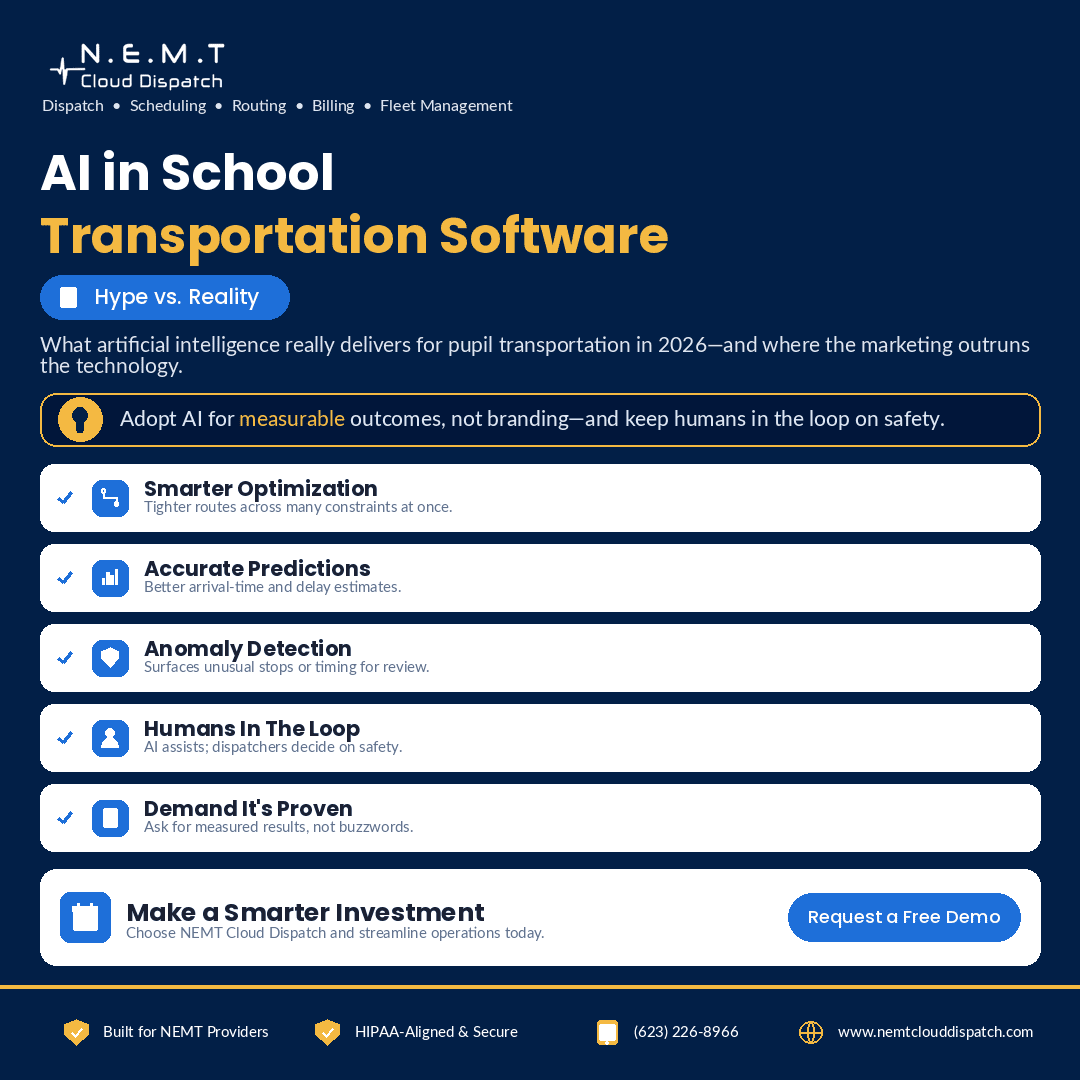
The strongest real-world applications are in optimization and prediction, where AI works on large amounts of routing and timing data to find patterns a human dispatcher cannot. Used well, it makes routes tighter and arrival estimates more accurate, and it can flag anomalies worth a closer look.
- Smarter route optimization across many constraints at once
- More accurate arrival-time and delay predictions
- Anomaly detection that surfaces unusual stops or timing
- Forecasting demand so you plan capacity before you need it
For most districts, AI is most useful when it improves route optimization software by analyzing stop locations, traffic patterns, vehicle capacity, student needs, and route timing together. These improvements can help reduce unnecessary miles, improve on-time performance, and create more realistic route plans.
AI can also support better scheduling software by helping transportation teams forecast demand, adjust routes as enrollment changes, and plan driver and vehicle assignments with fewer manual changes.
Where the hype outruns reality
Plenty of AI marketing describes capabilities that are really just rules-based automation, or that are not yet reliable enough for the safety-critical world of student transport. Fully autonomous routing with no human review, or predictions presented with more confidence than the underlying data supports, deserve healthy skepticism. AI assists dispatchers; it does not replace their judgment about children’s safety.
This is why AI should support, not replace, real-time dispatching software. Dispatchers still need final control when a bus is late, a route changes, a student is missing, a driver calls out, or a safety issue requires human judgment.
AI can also help drivers, but it should not overwhelm them. A simple driver app should give drivers clear route instructions, stop sequencing, updates, and communication tools without turning every decision into a black-box recommendation.
How to pressure-test an AI claim
When a vendor says AI, ask what specifically the model does, what data it learns from, and how the output is validated. Request a concrete before-and-after from a real district rather than a hypothetical. If the answer is vague or the demo cannot show the AI changing a real decision, treat the label as marketing.
- What exactly does the AI do, in one plain sentence?
- What data does it use, and how current is it?
- How is its output checked, and who has the final call?
- Can you show measured results from a comparable district?
AI claims should also be tested against parent communication and operational visibility. If a vendor says AI improves arrival estimates, ask how those estimates appear in the parent app for school bus tracking and whether parents receive accurate delay alerts automatically.
Administrators should also ask how AI-driven recommendations appear inside the school district transportation portal. A useful system should make route performance, exceptions, reports, and operational trends easier to understand—not hide important decisions behind vague AI language.
A practical stance for 2026
Adopt AI features for their measurable outcomes, not their branding. The right approach is to value the efficiency and prediction gains where they are proven, keep humans firmly in the loop on safety decisions, and let evidence rather than buzzwords drive the purchase.
Before choosing a vendor, compare AI claims against the actual product, implementation process, and total cost. Review the vendor’s school transportation software pricing so you know whether AI-powered routing, prediction tools, parent communication, onboarding, and support are included or sold as premium add-ons.
If you are comparing multiple platforms, use a structured best NEMT software comparison approach: evaluate the real workflow, feature depth, pricing transparency, support, reporting, and measurable operational outcomes rather than choosing the vendor with the loudest AI messaging.
Frequently Asked Questions
Does AI actually improve routing?
Yes, when it optimizes across many constraints on real data it can meaningfully tighten routes and improve arrival estimates. The gains should be measurable, so ask for evidence.
Is AI safe for student transportation?
AI should assist, not replace, human judgment on safety. Keep dispatchers in control of decisions that affect children and treat fully autonomous claims with caution.
How do I separate real AI from marketing?
Ask what the model does in one sentence, what data it uses, how output is validated, and for measured results from a comparable district. Vague answers signal hype.