Dialysis transportation is one of the most time-sensitive services an NEMT provider can manage. A missed pickup is not just an operational problem. It can affect a patient’s treatment schedule, create stress for caregivers, and damage trust with facilities, brokers, and families.
That is why dialysis trip scheduling requires more than a simple calendar. Providers need repeatable workflows, clear passenger notes, reliable driver assignments, smart routing, accurate billing records, and real-time communication between the office and the road team.
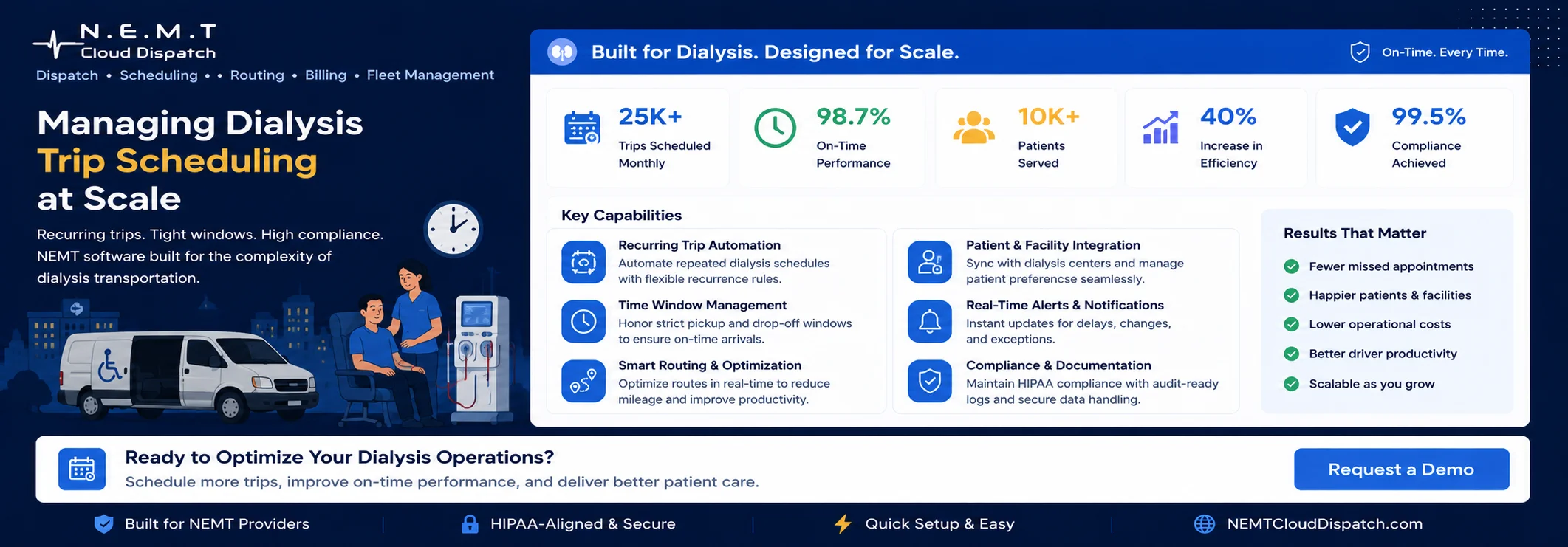
At NEMT Cloud Dispatch, we help transportation providers manage dispatching, scheduling, routing, fleet management, billing, broker support, and reporting from one organized platform. This guide explains how high-volume providers can manage dialysis rides at scale without adding chaos to daily operations.
Quick Answer: What Makes Dialysis Scheduling Hard at Scale?
Dialysis trip scheduling becomes difficult at scale because dialysis rides are recurring, appointment-sensitive, and often require consistent timing, mobility notes, driver coordination, and reliable documentation.
Many in-center hemodialysis treatments are usually scheduled three times per week, and each session may take several hours, according to the National Kidney Foundation. That creates a steady flow of repeat transportation demand that providers must manage carefully.
For NEMT companies, the challenge is not only getting patients to treatment. It is also managing return rides, delays, facility changes, standing orders, wheelchair needs, cancellations, no-shows, broker requirements, and billing details across dozens or hundreds of weekly trips.
Why Dialysis Trips Are Different From Regular NEMT Trips
Regular NEMT trips may be one-time appointments. Dialysis trips often follow a fixed weekly pattern. That makes them predictable in one way, but more demanding in another.
A dialysis passenger may need transportation every Monday, Wednesday, and Friday, or every Tuesday, Thursday, and Saturday. Pickup windows must match appointment times. Return rides may depend on treatment completion. Some passengers may require wheelchair-accessible vehicles, extra assistance, or specific driver instructions.
Strong dialysis transportation scheduling helps providers keep these details organized so dispatchers do not rebuild the same rides manually every week.
Non-emergency medical transportation is an important benefit for people who need help getting to and from medical appointments, according to CMS. For providers, this makes accuracy, documentation, and service reliability especially important.
1. Build a Reliable Standing Order Workflow
The first step in managing dialysis rides at scale is to standardize standing orders. Dispatchers should not enter the same trip again and again unless something changes.
A strong standing order workflow should include:
- Patient name and contact details
- Pickup and drop-off locations
- Treatment days
- Appointment time
- Preferred pickup window
- Return ride expectations
- Mobility needs
- Vehicle type
- Driver notes
- Broker or payer details
- Billing requirements
When providers manage recurring dialysis trips manually, errors become more likely. A missed schedule update or outdated note can create a late pickup, wrong vehicle assignment, or incomplete trip record.
With NEMT scheduling software, NEMT Cloud Dispatch helps providers manage repeat trips more efficiently so dispatchers can build reliable schedules and reduce repetitive work.
2. Keep Patient Notes Clear and Accessible
Dialysis transportation often depends on small details. A passenger may need door-to-door assistance, wheelchair support, oxygen-related notes, a specific entrance, caregiver contact details, or instructions from a dialysis center.
If those notes live in someone’s memory, a spreadsheet, or an old text message, the entire trip becomes harder to manage.
Your software should make notes easy to view for:
- Schedulers
- Dispatchers
- Drivers
- Billing staff
- Managers
This is especially important for dialysis ride scheduling, where the same passenger may ride multiple times per week. Clear notes help reduce repeat questions, improve driver confidence, and protect service consistency.
NEMT Cloud Dispatch keeps important trip information connected to the scheduling and dispatch workflow, helping teams work from one source of truth.
3. Match the Right Driver and Vehicle to Every Ride
At scale, assigning the wrong vehicle can create serious delays. A wheelchair passenger needs the right vehicle. A high-assistance passenger may need a trained driver. A facility with strict arrival windows needs dependable timing.
Good dialysis trip scheduling should help your team consider:
- Vehicle availability
- Driver availability
- Passenger mobility needs
- Route timing
- Service area
- Trip duration
- Pickup windows
- Return ride expectations
With NEMT fleet management software, providers can track vehicles, manage availability, and support better resource planning. NEMT Cloud Dispatch helps teams connect trip needs with drivers and vehicles more efficiently.
4. Optimize Routes Without Risking Appointment Times
Routing dialysis trips is not only about shortest distance. Providers must balance appointment times, pickup windows, treatment schedules, passenger needs, vehicle capacity, driver hours, and return trips.
Poor route planning can create:
- Late arrivals
- Long passenger wait times
- Extra miles
- Driver overtime
- Missed return rides
- Higher fuel costs
- Facility complaints
This is where software becomes essential. A strong routing workflow helps dispatchers group compatible rides, reduce unnecessary mileage, and respond faster when the day changes.
NEMT Cloud Dispatch supports routing and dispatch visibility through NEMT dispatch software, helping teams coordinate high-volume dialysis transportation with better control.
5. Prepare for Treatment Delays and Return Ride Changes
Dialysis sessions may not always end exactly on time. A patient may need extra monitoring, a facility may run behind, or a return ride may need to shift.
If your system cannot handle changes quickly, dispatchers may spend the entire day reacting to phone calls.
A scalable workflow should allow your team to:
- Adjust return rides
- Reassign drivers
- Update trip notes
- Communicate changes
- Track delayed pickups
- Document no-shows or cancellations
- Keep billing records clean
This is where NEMT dialysis transportation operations need flexibility. High-volume providers need software that can manage both planned schedules and real-world changes.
6. Coordinate With Facilities, Brokers, and Care Teams
Dialysis transportation often involves more than the passenger and the driver. Providers may coordinate with dialysis centers, caregivers, brokers, Medicaid transportation programs, case managers, or payer representatives.
To manage this well, your platform should organize:
- Facility details
- Broker trip IDs
- Contact information
- Authorization notes
- Pickup and drop-off rules
- Service requirements
- Trip documentation
- Billing status
NEMT Cloud Dispatch helps providers manage broker integration support and trip information more clearly, reducing the need to jump between disconnected systems.
For providers that handle protected health information in their workflows, HHS explains that business associates may perform certain services involving protected health information on behalf of covered entities. Providers should review vendor privacy and security practices carefully.
7. Connect Scheduling With Billing
A completed dialysis ride still needs accurate billing documentation. If dispatch, driver updates, broker records, and billing notes are disconnected, your revenue cycle can slow down.
Strong dialysis transportation software should help billing teams review:
- Completed trips
- Mileage
- Pickup and drop-off details
- Driver status updates
- No-shows
- Cancellations
- Broker information
- Service notes
- Export-ready trip records
With NEMT billing software, NEMT Cloud Dispatch helps providers keep trip details easier to review, reducing manual back-and-forth between dispatch and billing teams.
8. Use Reporting to Improve Performance
At scale, managers need more than daily trip lists. They need visibility into trends.
Useful dialysis transportation reports may include:
- Weekly trip volume
- Completed rides
- Cancellations
- No-shows
- Late pickups
- Driver productivity
- Vehicle utilization
- Facility volume
- Broker volume
- Billing status
- Route efficiency
Reporting helps owners identify what is working and what needs improvement. Without clear reporting, growth becomes guesswork.
This is one reason dialysis trip scheduling should be connected to dispatching, routing, fleet management, and billing. When all activity flows through one organized system, managers can make better decisions faster.
Common Dialysis Transportation Scheduling Mistakes
Many providers struggle because their workflows were built for small trip volume. As volume grows, old habits create bigger problems.
Avoid these mistakes:
- Managing repeat trips manually
- Keeping passenger notes outside the system
- Failing to update standing orders
- Assigning vehicles without checking mobility needs
- Ignoring return ride uncertainty
- Separating dispatch from billing
- Not tracking no-shows and cancellations
- Relying on phone calls for every update
- Using reports only after problems happen
Better dialysis transportation scheduling starts with repeatable processes and software that supports real-world NEMT operations.
How NEMT Cloud Dispatch Helps Providers Manage at Scale
NEMT Cloud Dispatch gives transportation providers a more organized way to manage high-volume medical transportation.
Our platform supports:
- Scheduling
- Dispatching
- Routing
- Fleet management
- Driver communication
- Broker support
- Billing workflows
- Trip documentation
- Reporting and visibility
For dialysis operations, this means your team can manage standing orders, assign drivers, track vehicles, adjust schedules, support billing review, and monitor service performance with less manual work.
The goal is simple: help providers deliver reliable service while managing more rides with better control.
Final Checklist for High-Volume Dialysis Scheduling
Use this checklist to improve dialysis trip scheduling before your next busy service week:
- Review all active standing orders
- Confirm pickup and drop-off locations
- Check appointment times
- Update patient mobility notes
- Verify vehicle requirements
- Review driver availability
- Confirm broker details
- Plan return ride flexibility
- Monitor route efficiency
- Track no-shows and cancellations
- Keep billing documentation complete
- Review weekly performance reports
If your current system cannot support these tasks easily, it may be time to consider better dialysis transportation software.
Conclusion
Managing dialysis rides at scale requires more than hard-working dispatchers. It requires the right workflow, clean data, reliable standing orders, driver coordination, routing visibility, billing support, and real-time operational control.
With NEMT Cloud Dispatch, providers can manage high-volume medical transportation more efficiently while improving dispatching, scheduling, routing, fleet management, broker support, and billing workflows.
If your team is ready to improve dialysis trip scheduling and manage more rides with less stress, Request a Demo with NEMT Cloud Dispatch today.
Frequently Asked Questions
What is the biggest challenge in managing dialysis trips?
The biggest challenge is consistency at scale. Dialysis rides often happen several times per week, so providers need accurate standing orders, reliable driver assignments, flexible return ride handling, and clean documentation.
Why are recurring dialysis trips hard to manage manually?
Recurring dialysis trips are hard to manage manually because one small change can affect multiple future rides. Manual systems increase the risk of outdated notes, missed updates, wrong vehicle assignments, and scheduling confusion.
How can software improve dialysis transportation?
Software helps providers organize schedules, dispatch drivers, manage route changes, track vehicles, document trip details, support broker workflows, and give billing teams cleaner records.
What should providers look for in a dialysis transportation platform?
Providers should look for scheduling, recurring trip support, dispatching, routing, driver communication, fleet visibility, billing workflows, broker support, reporting, and secure access controls.
How does NEMT Cloud Dispatch support dialysis transportation?
NEMT Cloud Dispatch helps providers manage scheduling, dispatching, routing, fleet management, billing, broker support, reporting, and driver communication in one organized platform.