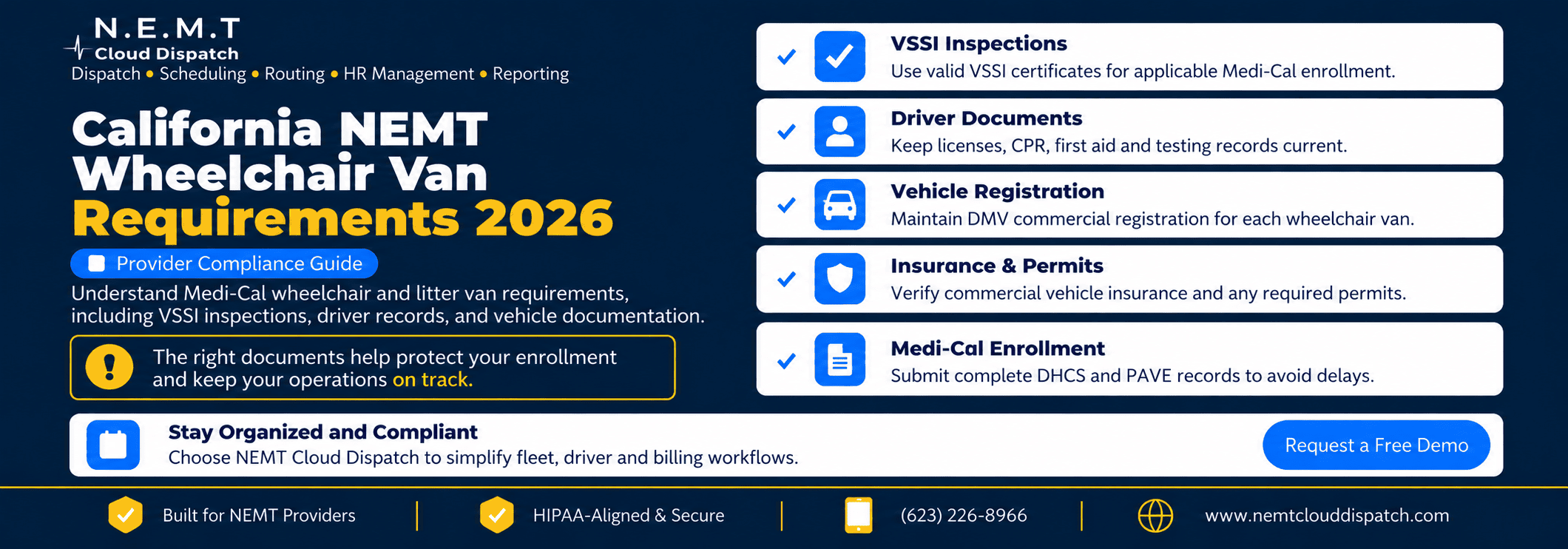
One expired inspection certificate driver document not received. One inaccurate car registration. Any of these difficulties can slow down a California NEMT provider’s Medi-Cal enrolment application.
For operators of wheelchair and litter vans, compliance begins before the first passenger is on board the vehicle. The California NEMT wheelchair van requirements are vehicle inspections, commercial registration, insurance, driver qualifications, and documents submitted to the Department of Health Care Services (DHCS).
Effective March 27, 2025, California introduced a major shift, mandating Vehicle Safety Systems Inspection (VSSI) certificates instead of the old brake and light certificates for applicable Medi-Cal NEMT enrolment applications.
At NEMT Cloud Dispatch, we know how difficult it is for transportation providers to schedule vehicles, drivers, and administrative data. This handbook provides information on California’s unique requirements, the VSSI transition, and documentation that operators should prepare for Medi-Cal enrolment in 2026.
1. California Medi-Cal Wheelchair and Litter Van Requirements
California’s Medi-Cal programme offers non-emergency medical transportation (NEMT) to qualifying beneficiaries who cannot use regular public or private transportation because of their medical conditions.
NEMT covers wheelchair vans, litter vans and ambulances under DHCS transportation services guidance.
Wheelchair vans offer wheelchair accessible transportation to qualifying clients. Litter vans are for people who need to travel laying down.
California wheelchair van Medi-Cal criteria established documentation standards for providers interested in participating in the programme.
What paperwork should providers be getting ready?
For relevant wheelchair and litter van enrolment applications, providers shall organize:
- Registration of commercial vehicle granted by DMV.
- Commercial vehicle insurance proof.
- Valid VSSI certificates if applicable.
- Permits required for special vehicles.
- Drivers licenses and supporting qualifications.
- Enrolment and business documentation required.
These records assist DHCS in determining whether applicants meet the necessary enrolment requirements.
For comprehensive instructions on how to apply, please refer to the official DHCS medical transportation provider enrolment checklist.
Important: NEMT is not the same as non-medical transportation (NMT). Providers should verify their enrolment category before filling out application forms.
2. California NEMT VSSI Certificate Requirements
One of the most significant parts of California wheelchair van enrolment is documentation of vehicle inspection.
Prior to this, needed NEMT applications required standard brake and light certificates.
California has now switched to the Vehicle Safety Systems Inspection programme.
What is a VSSI certificate?
A Vehicle Safety Systems examination certificate means the vehicle has passed the required examination through California’s Bureau of Automotive Repair (BAR) programme.
The inspection tests several vehicle safety systems following prescribed state protocols.
For providers looking into NEMT car inspection California regulations, this distinction is crucial.
A normal maintenance receipt or a general mechanical inspection does not automatically serve as a VSSI certificate that is technically required.
When did California implement the new requirement?
There were three major milestones to the transition:
- July 8, 2024: California started inspections under the VSSI programme.
- September 27, 2024: Discontinued former brake and light inspection programmes.
- March 27, 2025: DHCS no longer accepts the old certificates for relevant NEMT enrolment applications received on or after this date.
As on March 27, 2025, eligible applicants must possess a valid VSSI certificate.
DHCS confirmed this change in its revised Medi-Cal NEMT provider requirements.
What should providers do to prepare for inspection?
Before you schedule a VSSI inspection:
- Check the vehicle’s service history.
- Address recognized safety and mechanical concerns.
- Locate a BAR approved VSSI inspection facility.
- Perform complete inspection.
- Keep the certificate together with the vehicle documents.
Providers should also visit the California BAR Vehicle Safety Systems Inspection Program for official programme details.
The California NEMT VSSI certificate is the inspection paperwork for the applicable enrolment requirement. It is not a substitute for any applicable commercial transportation or accessibility duties.
3. California NEMT Vehicle Registration & Insurance Documents
Commercial registration and insurance records are a big part of the California NEMT wheelchair van requirements.
DHCS requires certain documentation to be submitted by wheelchair and litter van candidates.
Commercial vehicle registration at DMV
Providers are required to keep a copy of the commercial vehicle registration for each vehicle included on an application.
Before you submit, please ensure that:
- The VIN is a valid VIN.
- Registration details correspond to the application.
- The vehicle is registered under the proper classification.
- The registration document submitted is up to date.
If information is inconsistent or inaccurate, it may lead to extra questions throughout the application review process.
Insurance for commercial vehicles
DHCS also requires proof of commercial auto insurance.
Providers must verify that the insurance paperwork provided appropriately identify the covered business and the cars involved.
Check policy coverage dates before sending certificates with application packages.
Do not mistake commercial vehicle insurance with the separate requirements for company liability insurance.
Permits for special vehicles
Special vehicle permits, when appropriate, are noted on the DHCS enrolment checklist as necessary.
It is contingent upon the vehicle and the rules that apply. Do you need a permit?
Operators should check these responsibilities with the proper California authorities, and not assume every wheelchair van will have the same rules for permits.
4. Qualifications and Documentation for California NEMT Drivers
Vehicle approval does not signify a transportation provider’s readiness for enrolment.
Another key part of the California application process is driver records.
DHCS identified the California NEMT driver qualifications including licensure, certification, testing and medical examination paperwork.
What driver’s documentation do I need?
DHCS application checklist requires the following records for wheelchair and litter van drivers:
| Driver Document | Purpose of Enrolment |
|---|---|
| Driver licensing documents | California driver license |
| Printout of DMV driving record | Shows driving history |
| First aid certificate | First aid certification records |
| CPR certificate | CPR certification documents |
| Pre-employment drug test | Testing information necessary |
| Alcohol test lab results | Paperwork alcohol testing |
| MCSA-5875 and MCSA-5876 | Evidence of a medical checkup |
| Special driver licence | When necessary |
Providers must also meet any other license and qualification criteria applicable to their practice.
What can providers do to avoid documentation errors?
Keep a tidy and separate file for each driver.
Before submitting enrolment information, check licenses, certifications, medical documentation and any expiration dates.
If the driver changes vehicles or duties check to see if there are further criteria.
If you want to learn more about driver recruiting and operations, read our guide on NEMT driver requirements and professional qualifications.
They help ensure that the enrolment preparation goes more smoothly and that there is less uncertainty from the administrative side.
5. How To Fill Out A California Medi-Cal Wheelchair Van Enrolment Form
Understanding the Medi-Cal wheelchair van provider requirements before applying helps providers collect the information DHCS needs.
California employs the Provider Application and Validation for Enrolment (PAVE) system for applicable provider enrolment operations.
Step 1. Collect company documentation
Have ready the necessary business identification, ownership, license, insurance and supporting application records.
Ensure names and addresses remain consistent across documents.
Step 2: Gather vehicle information
For each wheelchair or litter van, get the registration, commercial vehicle insurance, the requisite VSSI certificate and the necessary permit papers.
Step 3. Check driver credentials
Check all the driver’s licenses, driving records from the DMV, certifications, tests, and medical examination forms.
Step 4: Use the correct enrolment process
Follow the current DHCS application guidelines and follow the proper PAVE enrolment process.
Providers currently enrolled and revising their enrolment information need to evaluate if a supplemental change application is required.
Step 5: Check application communications
Respond to requests for clarification or additional documentation from DHCS.
Submission of an application does not immediately authorize a provider to bill Medi-Cal.
DHCS told us that only enrolled providers that have been approved to deliver NEMT services are allowed to submit a claim for such services.
Practical Tip: Before you begin the application process, create a document checklist for each vehicle and driver. This highlights missing information.
6. Common California Wheelchair Van Enrolment Errors
Even organized moving companies sometimes leave out details throughout the enrolment procedure.
Beware of these common issues:
- Submitting old inspection documents: The VSSI transition does not include traditional brake and light certificates for applicable applications.
- Inconsistent vehicle information: Registration information must match information given to DHCS.
- Missing driver documentation: Inadequate certifications, driving records or testing information can make application screening difficult.
- Documentation for NMT enrolment: The documentation used for NMT enrolment may not be the same as for NEMT wheelchair van providers.
- Non-compliance with necessary permits: Special vehicle permits must be complied with if required.
- Assuming submission of application equals approval: Providers must be approved for enrolment before billing Medi-Cal.
It’s better to check this information prior to submission than it is to have to deal with avoidable documentation issues later.
For a more detailed operational supervision, visit our 2026 NEMT compliance checklist. This companion material is designed to focus on general audit preparation, not California-specific enrolment rules.
7. How NEMT Cloud Dispatch Helps Manage Transportation Operations
To comply with California’s wheelchair transportation requirements, you need precise paperwork and reliable operational coordination.
The supplier still needs to get regulatory permissions, but the proper technology can ease the administrative burden.
NEMT Cloud Dispatch offers transportation management software that is meant to support:
- Vehicle management: Manage vehicle information and enhance operational insight.
- Driver coordination: Arrange driver availability and transport timetables.
- Dispatching and Routing: Make wheelchair transportation journeys more efficient.
- Billing workflows: Streamline transportation billing administrative tasks.
- Broker support: enhances communication and coordination through transportation procedures.
Our technology empowers transportation operators to run their daily business without having to fall back on disconnected processes.
However, NEMT Cloud Dispatch is not responsible for generating VSSI certificates, authorizing Medi-Cal enrolment, or replacing formal compliance verification.
Transportation management capabilities enable providers to spend less time coordinating regular chores and more time delivering reliable service.
8. Frequently Asked Questions
1. What should I know about Running a Medi-Cal NEMT Wheelchair Van in California?
California NEMT wheelchair van regulations include proper registration of a commercial vehicle, insurance, VSSI certification (if applicable), permits, driver documentation, and approved enrolment as a Medi-Cal provider. Other vehicle safety and passenger transit regulations may apply.
2. What is a Vehicle Safety Systems Inspection Certificate?
A VSSI certificate is an inspection document performed by the California Bureau of Automotive Repair programme. This replaces the prior brake and light certificate for qualifying Medi-Cal wheelchair and litter van enrolment applications.
3. When did California switch from brake and light certifications to VSSI certificates for NEMT enrolment?
The former inspection programmes were terminated by California on September 27, 2024. Effective March 27, 2025, DHCS started requiring VSSI certificates for relevant NEMT enrolment applications.
4. What driver documents are required of California wheelchair van providers?
DHCS provides California driver’s license, DMV driving record, first aid and CPR certificates, drug and alcohol testing records, MCSA-5875 and MCSA-5876 forms, and special driver permits where appropriate.
5. What are the required commercial registration and insurance documents?
Applicants must have proper commercial vehicle registration and proof of commercial vehicle insurance with the DMV. The enrolment checklist may also demand separate documentation of commercial liability insurance.
6. NEMT fleet management software provides the following ways for suppliers to track vehicle documentation:
Fleet management software assists operators in organizing vehicle information and managing the associated transportation procedures. NEMT Cloud Dispatch provides coordination of fleets, dispatching, scheduling, billing and broker activities. Healthcare providers should verify the document management capabilities of any software they want to use to retain compliance records.
Conclusion: NEMT Cloud Despatch Makes California NEMT Simple
Understanding the California NEMT wheelchair van requirements helps suppliers complete accurate enrolment applications and maintain critical vehicle and driver documentation.
Given the move to VSSI certification, it is even more critical to study current DHCS criteria rather than relying on obsolete inspection recommendations.
While the supplier is responsible for official compliance, good transport management can reduce the amount of unneeded paperwork.
NEMT Cloud Dispatch is here to assist NEMT companies with dispatching, routing, fleet coordination, billing and broker operations.
Ready to take wheelchair transportation operations to the next level?
Request a Demo of NEMT Cloud Dispatch and experience how our software can make your team’s operations more efficient.
Disclaimer: This article is for general educational purposes. Before you submit the application, check with DHCS, BAR and other relevant California authorities to confirm current enrolment, inspection, licensing and insurance requirements.