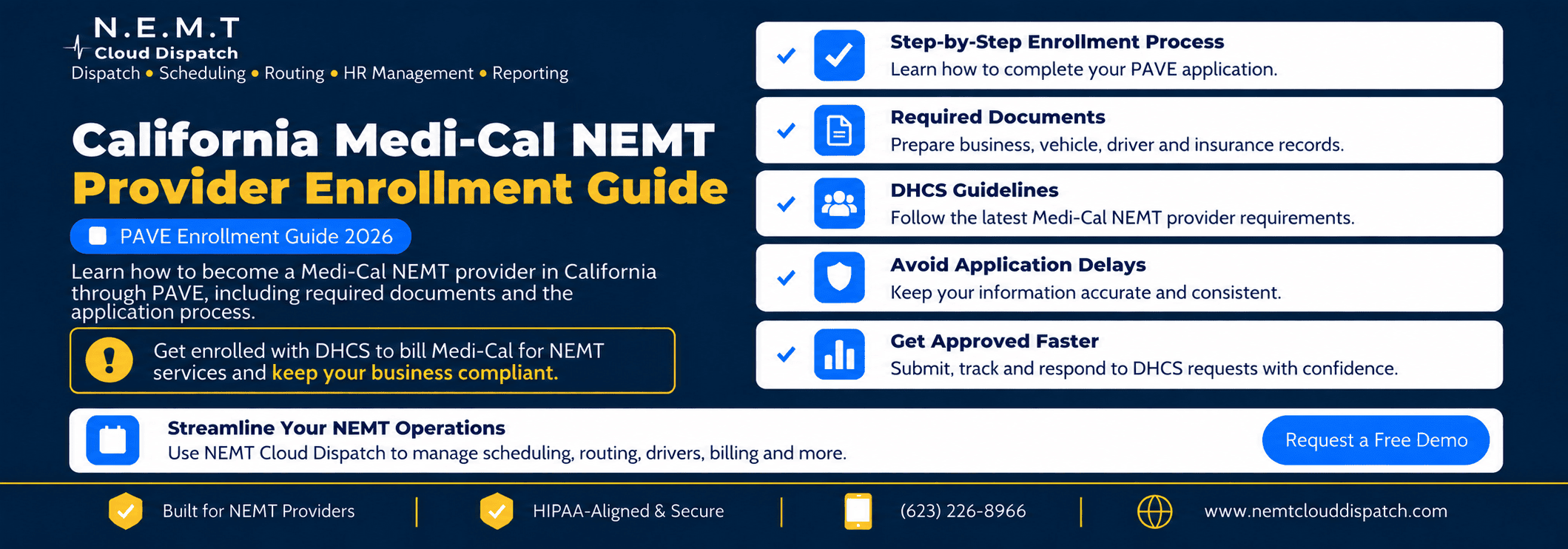
California Medi-Cal NEMT provider enrollment is a state process managed by the California Department of Health Care Services (DHCS) through PAVE. Starting a transportation company and becoming an enrolled Medi-Cal provider are different steps. Your application must be supported by business, insurance, vehicle, driver, ownership, and signer records that match the information submitted through PAVE.
If you are researching how to become an NEMT provider in California, this guide stays focused on enrollment. It does not repeat general advice about forming an LLC, pricing, marketing, or finding riders. Instead, it explains how to prepare the Medi-Cal NEMT provider application, organize the supporting file, submit through PAVE, respond to DHCS, and understand what enrollment approval does—and does not—give you.
California Medi-Cal NEMT Provider Enrollment: What PAVE Means
PAVE stands for Provider Application and Validation for Enrollment. DHCS uses the web-based portal for provider applications, document uploads, electronic signatures, application tracking, changes to existing enrollments, and responses to Provider Enrollment Division requests.
DHCS Provider Application and Validation for Enrollment (PAVE)
For California NEMT PAVE enrollment, treat the application and supporting documents as one connected record. Do not enter one version of a business name in PAVE while submitting insurance, licenses, leases, or IRS records under another version unless DHCS instructions specifically account for the difference.
DHCS NEMT provider enrollment establishes Medi-Cal provider status for the applicable provider type. It does not automatically create contracts with every Medi-Cal managed care plan or transportation broker.
Step 1: Build the Enrollment File Before You Start PAVE
California Medi-Cal NEMT provider enrollment begins before you open the first application screen.
DHCS lists records that may apply to transportation applicants, including FEIN or ITIN verification, local licenses or permits, fictitious business name documentation, partnership or corporate records, a lease when applicable, liability insurance, workers’ compensation documentation when applicable, and identification for the authorized signer.
DHCS Medical Transportation Provider Application Information
For the Medi-Cal NEMT provider application, create one enrollment folder containing the current version of each required record. Check that the applicant name, business address, ownership details, and signer information are consistent.
For general formation or licensing guidance, use the separate NEMT business licensing guide. This page should own the California Medi-Cal enrollment package.
Step 2: Verify Insurance and Premises Records
The California medical transportation provider requirements published by DHCS include commercial liability coverage of at least $100,000 per claim and a minimum annual aggregate of $300,000. Workers’ compensation documentation is required when the business has one or more employees; when it is not required, DHCS says an explanation must be provided.
For California NEMT PAVE enrollment, review names, addresses, dates, and policy information before uploading certificates. A mismatch between the application and supporting records can create avoidable questions during review.
Step 3: Prepare Wheelchair and Litter Van Records
Vehicle documentation can be a critical part of California Medi-Cal NEMT provider enrollment, especially for providers using wheelchair or litter vans.
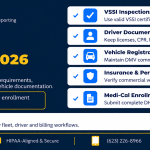
For a California wheelchair van provider application, DHCS lists records such as DMV commercial vehicle registration, proof of commercial vehicle insurance, a Vehicle Safety Systems Inspection certificate when applicable, and a special vehicle permit when applicable.
DHCS no longer accepts the former standard brake-and-light certificate for NEMT applications received on or after March 27, 2025. When applicable, providers must instead submit a valid Vehicle Safety Systems Inspection (VSSI) certificate issued by the Bureau of Automotive Repair.
DHCS Updated Medi-Cal NEMT Provider Requirements
For a California wheelchair van provider application, verify that the VIN, plate, registration, commercial insurance, inspection record, and applicable permit all refer to the same vehicle.
Step 4: Build a Separate File for Each Applicable Driver
DHCS identifies driver records that may apply to litter and wheelchair van operations, including a DMV driving record printout, First Aid and CPR certificates, pre-employment drug-testing documentation, alcohol test results, a California driver’s license, MCSA 5875 and MCSA 5876, and a special driver permit when applicable.
For DHCS NEMT provider enrollment, keep a separate file for each applicable driver. Check that names match, documents are legible, certifications are current, and permits are present where required.
This is where California medical transportation provider requirements meet document control. For ongoing monitoring after approval, use the NEMT compliance checklist instead of turning this page into a general compliance guide.
Step 5: Complete and Review the PAVE Application
Once the supporting file is ready, begin California NEMT PAVE enrollment in the DHCS portal.
PAVE allows providers to complete and submit applications, upload documents, electronically sign forms, track progress, report changes, and respond to enrollment-related requests.
The Medi-Cal NEMT provider application should match the evidence you already assembled. Before e-signing, verify the legal entity, service location, ownership information, signer authority, vehicles, drivers, and uploaded documents.
DHCS also states that medical transportation applicants are subject to an application fee. Check the current amount through DHCS when you apply rather than relying on an old article or screenshot.
Step 6: Track the Application and Respond to DHCS
Submitting the application does not complete California Medi-Cal NEMT provider enrollment.
Maintain an internal enrollment log showing the submission date, application status, any clarification requested, the responsible staff member, response date, and replacement or supplemental record provided.
For DHCS NEMT provider enrollment, respond from the same source file used to prepare the application. If DHCS asks for corrected insurance, another driver document, or an updated record, preserve the request and corrected document together.
Step 7: Understand What Enrollment Approval Actually Gives You
California Medi-Cal NEMT provider enrollment establishes the provider’s approved Medi-Cal enrollment status for the applicable provider type and service. DHCS states that only enrolled providers approved to render NEMT services may bill Medi-Cal for those services.
Approval does not automatically place the provider in every managed care plan or transportation broker network.
DHCS explains that providers first submit a provider enrollment application through the Provider Enrollment Division. Enrolled providers can subsequently contract with individual Medi-Cal managed care plans to become network providers.
DHCS Information for Medi-Cal Providers
Think of the process as two separate milestones:
- DHCS/PAVE enrollment: become an enrolled Medi-Cal provider for the applicable provider type and service.
- Managed care or broker participation: complete separate plan contracting, credentialing, or broker onboarding when required.
This distinction matters when researching how to become an NEMT provider in California. “Enrolled with Medi-Cal” and “contracted with a specific plan or broker” are not interchangeable.
For the second milestone, see NEMT Cloud Dispatch broker integrations rather than expanding this PAVE guide into a trip-acquisition article.
Step 8: Keep Enrollment Information Current After Approval
After California Medi-Cal NEMT provider enrollment, retain the approval, application records, vehicle files, driver files, and later changes submitted through PAVE.
PAVE supports changes to existing enrollments, so the original application should remain an active reference rather than becoming a forgotten archive.
For an approved California wheelchair van provider application, keep applicable vehicle and driver information current as operations change.
Broader Medi-Cal transportation business requirements after approval belong primarily in your compliance, broker, and billing resources. Here, the key point is to keep enrollment information accurate.
How NEMT Cloud Dispatch Fits After Enrollment
NEMT Cloud Dispatch does not replace PAVE, DHCS review, or the Medi-Cal NEMT provider application.
Once approved, providers can use NEMT Cloud Dispatch for scheduling, dispatch, routing, driver activity, broker integrations, billing, and reporting. State enrollment establishes provider status; software helps the approved company operate efficiently.
Explore NEMT Cloud Dispatch software
Frequently Asked Questions
How do I become an approved Medi-Cal NEMT provider in California?
If you are researching how to become an NEMT provider in California, review current DHCS transportation enrollment instructions, assemble the applicable business, insurance, ownership, premises, vehicle, driver, and signer records, and submit through PAVE.
What is PAVE for California NEMT providers?
PAVE is DHCS’s Provider Application and Validation for Enrollment portal. It supports applications, document uploads, electronic signatures, progress tracking, changes to existing enrollments, and responses to enrollment requests. It is the central platform for California NEMT PAVE enrollment.
What documents are required for Medi-Cal NEMT enrollment?
The California medical transportation provider requirements can include business identity records, local licenses or permits, insurance, ownership records, premises documentation, vehicle records, driver documents, inspections, permits, and signer identification depending on the provider and service type.
Do California NEMT providers need commercial vehicle insurance?
Yes. DHCS lists proof of commercial vehicle insurance among applicable litter and wheelchair van documents. Business liability insurance requirements also apply to the provider enrollment package.
Can a new NEMT business enroll with Medi-Cal before providing transportation?
A new company can begin the Medi-Cal enrollment process after it has assembled the applicable enrollment records and prerequisites. However, only enrolled providers approved to render NEMT services may bill Medi-Cal for those services.
What should providers do after Medi-Cal enrollment approval?
Keep approval records current, maintain applicable vehicle and driver documentation, and pursue managed care or broker contracting separately when needed. DHCS NEMT provider enrollment and network contracting are distinct steps.
Make the PAVE File the Center of Enrollment
A successful Medi-Cal provider enrollment process in California is not a generic startup checklist. It is a controlled DHCS application workflow built around accurate records.
Prepare the business file. Gather each applicable vehicle and driver record. Confirm VSSI documentation when required. Complete the Medi-Cal NEMT provider application from those source records. Submit through PAVE, track DHCS requests, understand what approval provides, and handle network contracting separately.
The clean sequence is:
Prepare → Apply in PAVE → Respond to DHCS → Receive Enrollment Approval → Pursue Separate Network Contracting → Begin Connected Operations
Once enrollment is in place, NEMT Cloud Dispatch can help your team connect scheduling, dispatch, routing, drivers, broker workflows, billing, and reporting in one operating environment.
Request a Demo to see how NEMT Cloud Dispatch can help organize daily NEMT operations after your Medi-Cal enrollment is approved.