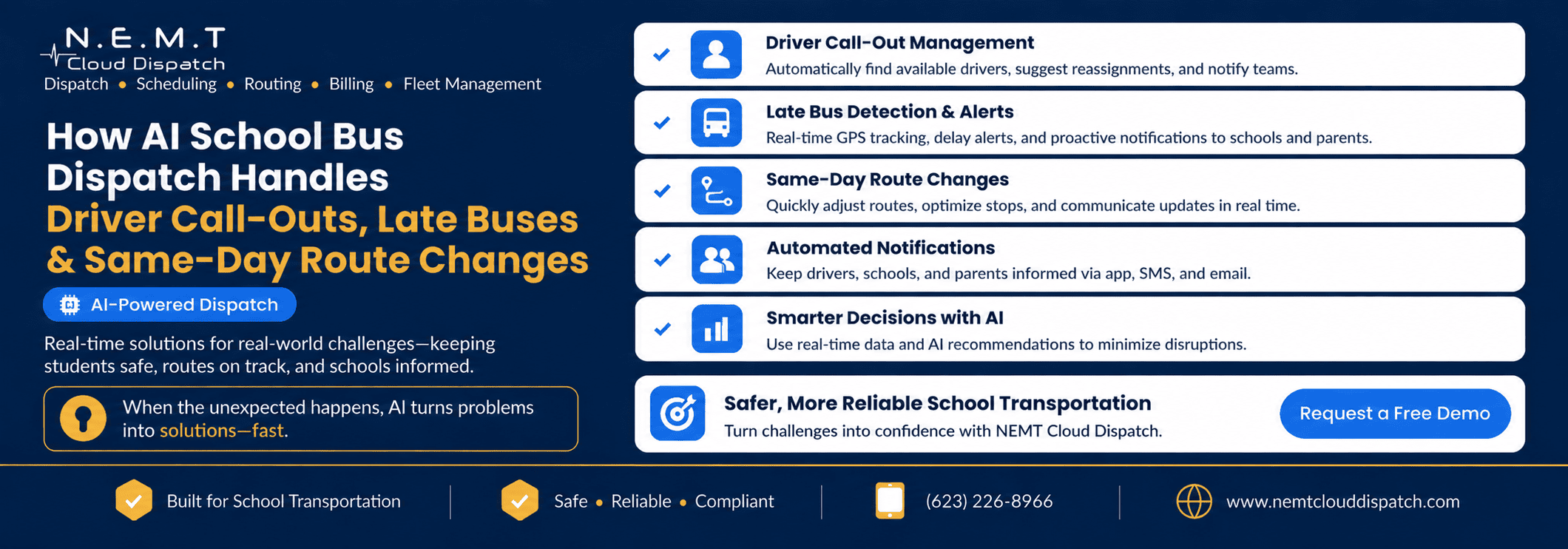
A school bus schedule can look perfect at 5:00 a.m. and be outdated 20 minutes later.
A driver calls out. One bus does not clear its pre-trip inspection. Traffic slows an elementary route. Construction closes a street. A substitute driver needs unfamiliar stops. Meanwhile, bell times have not moved.
AI school bus dispatch helps transportation teams respond to those disruptions by evaluating live operational data, identifying workable alternatives, and reducing the amount of manual rebuilding required when the day changes.
The important distinction is that AI should support dispatcher decisions—not make safety-critical transportation decisions without human oversight.
Quick Answer: How Does AI School Bus Dispatch Work?
AI school bus dispatch combines current route, driver, vehicle, GPS, timing, and student requirements to help transportation teams respond to disruptions.
When something changes, the system can identify the affected runs, evaluate available drivers or vehicles, re-optimize stops, update estimated arrival times, and surface possible recovery options. The dispatcher reviews the recommendation, approves the appropriate response, and sends the updated assignment to the driver.
A practical workflow looks like this:
Detect → Evaluate → Recommend → Approve → Update → Monitor
That is the real value of AI-assisted dispatch: helping a dispatcher move from discovering a problem to evaluating the best workable response faster.
What Is AI School Bus Dispatch?
AI school bus dispatch is the use of optimization, prediction, automation, and real-time operational data to help manage active school transportation routes when conditions change.
It can support decisions involving:
- Driver availability
- Vehicle availability
- Bell times
- Route timing
- Stop sequences
- Vehicle capacity
- GPS position
- Traffic conditions
- Student transportation requirements
- Substitute assignments
- Expected arrival times
It is different from basic route planning.
Route planning asks:
“What should tomorrow’s routes look like?”
Real-time dispatch asks:
“Route 17 has a problem right now. What is the best workable response using the drivers, buses, and time we still have?”
For a broader discussion of where artificial intelligence genuinely helps—and where AI marketing can get ahead of reality—see NEMT Cloud Dispatch’s AI in School Transportation Software: Hype vs. Reality guide.
How AI-Assisted Dispatch Responds to Common School Bus Problems
| Disruption | What the system can evaluate | What dispatch still needs to verify |
|---|---|---|
| Driver call-out | Available drivers, scheduled runs, location, qualifications, timing | Appropriate driver and operational impact |
| Bus unavailable | Available vehicles, capacity, route requirements | Vehicle suitability and readiness |
| Late route | GPS position, route progress, remaining stops, ETA | Whether intervention is necessary |
| Road closure | Current location, remaining stops, possible alternatives | Safety and suitability of changed routing |
| Same-day student change | Route, stop, capacity, timing | Authorization and student requirements |
| Route reassignment | Driver, vehicle, stops, bell times, workload | Final operating decision |
The technology is valuable because it evaluates several constraints together rather than forcing a dispatcher to compare them across separate spreadsheets, maps, radios, and applications.
How AI Handles a School Bus Driver Call-Out
Driver call-outs are a good example of where school bus dispatch automation can reduce repetitive work.
Without connected software, dispatch may need to identify the driver’s routes, find available substitutes, check vehicles, determine whether the replacement can make the bell time, send route information, and then notify other people manually.
AI-assisted dispatch can shorten that process.
1. Identify Everything the Driver Was Scheduled to Operate
The system should first identify the complete effect of the absence—not simply the first morning run.
That may include:
- Multiple morning routes
- Midday runs
- Special-needs transportation
- Afternoon assignments
- Activity transportation
This prevents dispatch from fixing the first problem while unintentionally creating another later in the day.
2. Evaluate Replacement Options
A useful system can compare available drivers against factors such as current schedule, route timing, assigned work, and applicable qualifications.
NEMT Cloud Dispatch’s transportation workforce management tools connect driver records and certifications with operational dispatch data, helping prevent the availability question from being separated from the qualification question.
3. Recalculate the Operational Impact
If simply replacing the driver is not possible, the system may evaluate alternatives such as:
- Reassigning the complete route
- Splitting stops between other routes
- Consolidating compatible runs
- Reassigning another driver’s later work
- Changing vehicle assignments
- Adjusting departure sequence
This is where school bus route reassignment becomes an optimization problem rather than a simple drag-and-drop action.
The best option is not always the geographically closest driver. Bell times, available capacity, subsequent assignments, and student-specific requirements can change the answer.
4. Push the Approved Assignment to the Driver
Once dispatch approves the change, the replacement driver needs the current route immediately.
A connected school transportation driver app can provide the manifest, stop sequence, navigation, applicable student notes, and updated instructions without requiring dispatch to reconstruct the entire route over the radio.
How AI Helps With School Bus Delay Management
A late bus becomes much easier to manage when dispatch knows about the problem before the first parent calls.
Modern school bus delay management depends on comparing what was planned with what is actually happening.
Detect the Delay
Real-time school bus dispatch can monitor signals such as:
- Late yard departure
- Current GPS position
- Route progress
- Longer-than-expected stop times
- Traffic conditions
- Route deviation
- Remaining stops
- Estimated school arrival
The important question is not simply whether a bus is “late.”
The system should help determine what the delay will affect next.
Predict the Downstream Impact
Suppose a bus is 12 minutes behind schedule.
That may be manageable if it has one school destination and no immediate follow-up work.
The same 12-minute delay may be much more important if the driver must begin a second route immediately afterward.
AI and optimization can help evaluate that downstream impact earlier.
Recommend the Appropriate Response
Depending on the situation, dispatch may decide to:
- Continue the route and monitor it
- Notify the receiving school
- Update families
- Move part of the run to another vehicle
- Adjust the following assignment
- Reroute around an obstruction
The objective is not to force every late bus back onto its original timetable. The objective is to find the safest workable operating plan using current information.
How Same-Day School Bus Route Changes Work
Same-day changes are where static routing systems become frustrating.
A route created last week cannot anticipate every road closure, student change, driver absence, or vehicle problem.
Connected route optimization and scheduling software can re-evaluate the current operation when a constraint changes rather than requiring the routing team to rebuild everything manually.
A typical same-day workflow is:
- An exception occurs.
A road closes, driver becomes unavailable, bus is removed from service, or another operational change is reported. - The affected run is identified.
Dispatch sees the driver, vehicle, students, remaining stops, and later assignments connected to the problem. - The system evaluates alternatives.
Available resources and route constraints are compared. - Dispatch reviews the recommendation.
A human confirms the change makes operational and safety sense. - The revised assignment is published.
Drivers receive the updated route or stops. - ETAs and communications are updated.
Schools and families receive relevant information when the change affects them. - Dispatch monitors the result.
The problem is not considered solved until the revised operation is actually working.
That final step matters. Automation should not treat “route successfully reassigned” as the same thing as “students successfully transported.”
How Real-Time School Bus Rerouting Works
Real-time school bus rerouting is the adjustment of an active route after the bus has already begun service.
Consider a road closure halfway through a morning run.
A useful rerouting system needs more than a different line on a map. It should consider:
- Where the bus is now
- Which stops have already been completed
- Which students are on board
- Which stops remain
- Current road conditions
- Vehicle constraints
- Bell-time impact
- Subsequent driver assignments
The system can then calculate an updated path or stop sequence.
But that recommendation still needs operational context.
NHTSA notes that routing software can help calculate and optimize school bus routes, while also warning that algorithms depend on accurate input data and properly configured safety rules. NHTSA’s school bus route-planning guidance reinforces why a mathematically efficient route is not automatically an appropriate school bus route.
That is why real-time school bus rerouting should remain human-supervised.
What Should Be Automated—and What Should Stay With the Dispatcher?
This is where many AI discussions become unrealistic.
The purpose of school bus dispatch automation should be to automate calculations, monitoring, repetitive updates, and information retrieval.
Good candidates for automation include:
- Detecting late starts
- Surfacing route exceptions
- Recalculating ETAs
- Comparing replacement options
- Re-optimizing stop sequences
- Identifying available resources
- Sending approved updates
- Triggering relevant notifications
Human dispatchers should remain responsible for decisions requiring context, judgment, escalation, or safety interpretation.
NIST’s AI Risk Management Framework emphasizes defining human roles and oversight when AI is used in operational environments. NIST’s AI Risk Management Framework provides a useful broader framework for thinking about responsible AI-assisted decision-making.
For student transportation, a practical rule is:
Let AI narrow the options. Let the dispatcher make the decision.
AI Is Only as Useful as the Operational Data Behind It
There is another limitation that software marketing sometimes ignores.
AI cannot make a useful dispatch recommendation from bad operational data.
For effective AI-assisted dispatch, the system needs current information about:
- Active routes
- Driver availability
- Driver qualifications
- Vehicle status
- Vehicle capacity
- GPS location
- Student assignments
- Bell times
- Transportation requirements
- Completed and remaining stops
This is why an integrated platform matters.
If routing lives in one system, GPS in another, driver schedules in a spreadsheet, and student requirements somewhere else, the dispatch engine is working with an incomplete picture.
For students with specialized transportation requirements, this becomes particularly important. NEMT Cloud Dispatch’s special-needs school transportation software is designed to keep transportation accommodations connected to route and assignment decisions.
Communication Should Follow the Dispatch Decision
Solving the route problem is only half the job.
When a different bus is assigned, a route runs late, or a detour changes arrival time, affected families may need updated information.
A connected school transportation parent app can carry live bus location, updated ETAs, route-change information, and relevant notifications from the same transportation operation.
That creates a better sequence:
Dispatch fixes the problem → system updates the operation → affected users receive the information they need.
Instead of:
Dispatch fixes the problem → parents start calling → office staff asks dispatch what happened → information is manually repeated.
What to Look for in an AI School Bus Dispatch System
Do not evaluate a platform based on how often its website uses the word “AI.”
Ask vendors to demonstrate a real exception.
For example:
“Our Route 22 driver called out 25 minutes before pull-out. Show us exactly what happens next.”
Then look for whether the platform can:
- Identify all affected runs
- Show available replacement drivers and vehicles
- Account for relevant constraints
- Reassign a complete or partial route
- Recalculate timing
- Push the approved route to the replacement driver
- Update dispatch visibility
- Communicate the change
- Preserve human control
- Record what changed
If the vendor cannot demonstrate that workflow, the AI label matters far less.
How NEMT Cloud Dispatch Supports Real-Time School Transportation
NEMT Cloud Dispatch combines route-based K-12 transportation with live dispatch, route re-optimization, driver applications, special-needs transportation requirements, and parent-facing communication.
The school transportation software platform connects the planned route with what happens during the actual transportation day, while the dedicated real-time transportation dispatch platform gives dispatchers visibility into active drivers, vehicles, runs, and exceptions.
The goal is not autonomous school transportation.
It is faster, better-informed exception management with the dispatcher still in control.
Frequently Asked Questions
What is AI school bus dispatch?
AI school bus dispatch uses optimization, prediction, automation, and live transportation data to help dispatchers respond to driver absences, delays, vehicle problems, route changes, and other day-of-service disruptions. AI can evaluate options and update calculations while the dispatcher retains control over operational decisions.
Can AI automatically reassign a school bus route?
AI-assisted systems can evaluate available drivers, vehicles, capacity, route timing, bell times, and other constraints to recommend or support school bus route reassignment. The final reassignment should still be reviewed against district policy, safety requirements, and operational context.
Can AI help when a school bus is running late?
Yes. AI and optimization can support school bus delay management by comparing scheduled and actual route progress, recalculating ETAs, identifying downstream impacts, and helping dispatch determine whether the route should continue or receive operational support.
How does real-time school bus rerouting work?
Real-time school bus rerouting uses current vehicle location, remaining stops, road conditions, route constraints, and schedule requirements to calculate an updated route when the original path is disrupted. The recommended change should be reviewed by dispatch before being put into service.
Does AI replace school bus dispatchers?
No. The strongest use of AI is assisting dispatchers with calculations, predictions, monitoring, and option evaluation. Decisions involving student safety, unusual circumstances, policy, or incomplete information still require experienced human judgment.
See AI-Assisted Dispatch With One of Your Real Scenarios
The easiest way to evaluate AI school bus dispatch is not with a generic feature presentation.
Test it against your operation.
Bring NEMT Cloud Dispatch a real example: a driver call-out, late morning route, unavailable bus, special-needs reassignment, road closure, or same-day schedule change.
See how the platform connects the route, available resources, dispatch decision, driver update, and operational visibility in one workflow.
Book a personalized NEMT Cloud Dispatch demo and use one of your real dispatch challenges as the test case.