NEMT claim denials usually start long before a bill is submitted. In 2026, providers that want faster payment need tighter controls around dispatch-to-billing handoffs, because NEMT billing errors, weak NEMT billing compliance, incomplete NEMT trip documentation, broken NEMT claims processing, and avoidable NEMT reimbursement delays often come from the same operational gaps. CMS says Medicaid transportation providers need to understand billing rules, prevent fraud and abuse, and make sure records support the services billed.
At NEMT Cloud Dispatch, we help providers connect dispatching, routing, fleet management, billing, and broker support in one platform. The best way to prevent rejections is to run a pre-submission review that catches NEMT claim denials before they happen. That review should target the most common NEMT billing errors, confirm NEMT billing compliance, verify NEMT trip documentation, clean up NEMT claims processing issues, and reduce NEMT reimbursement delays before the claim leaves your office. Explore our NEMT Invoicing & Billing Software, NEMT Dispatching Software, and NEMT Brokerages Software to see how those workflows connect.
Quick answer
Most NEMT claim denials are caused by simple breakdowns: missing authorization details, status mismatches, weak notes, or unsupported charges. Those same breakdowns create NEMT billing errors, weaken NEMT billing compliance, leave gaps in NEMT trip documentation, slow NEMT claims processing, and increase NEMT reimbursement delays after submission. Public NEMT billing guides and state manuals consistently point to documentation gaps, duplicate claims, mileage discrepancies, timely filing problems, and unsupported services as major denial drivers.
Why rejection risk is rising in 2026
Claim prevention matters more now because brokers, payers, and regulators are leaning harder on documentation quality, payment integrity, and real-time data exchange. NEMTAC’s standards work highlights timely reimbursement, provider oversight, interoperability, and cleaner data exchange across providers, brokers, payers, and technology platforms. That means a weak back-office process is no longer just an accounting issue. It is an operational risk. Review the NEMTAC Broker Standard Overview and the NEMTAC Data Exchange Standard Overview.
In practice, that means providers need a cleaner review system before billing starts. Fixes 1-4 prevent NEMT claim denials at the trip level. Verify the rider, authorization, timestamps, and trip status; those steps alone remove many NEMT billing errors, strengthen NEMT billing compliance, improve NEMT trip documentation, simplify NEMT claims processing, and cut NEMT reimbursement delays later.
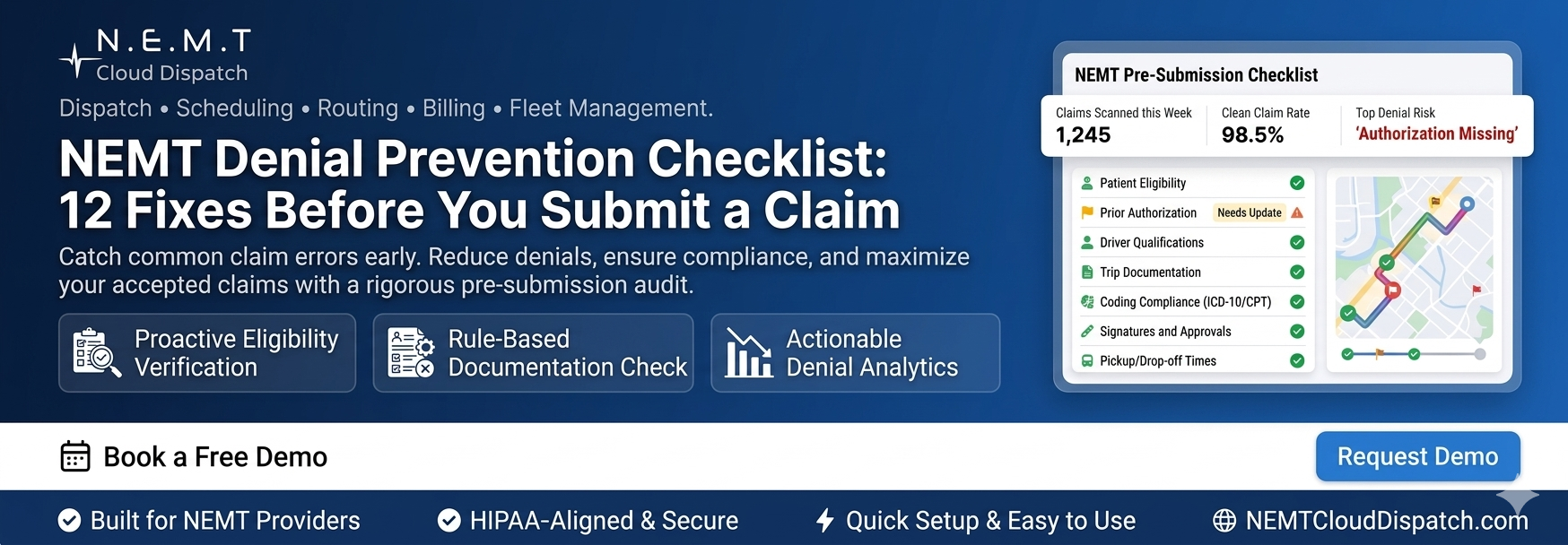
The 12-fix checklist before you submit
1) Verify rider eligibility and authorization
Confirm the member was eligible on the date of service and that the authorization, if required, matches the actual trip.
2) Confirm pickup and drop-off times
Do not bill from memory. Use the final service record, not a partial status update.
3) Match the assigned driver and vehicle to the final trip
Make sure the record reflects who actually completed the ride.
4) Resolve no-shows, reroutes, wait time, and cancellations
Do not let unresolved exceptions roll into billing.
The next group of fixes protects the claim from preventable back-office mistakes. Clear service notes, mileage review, duplicate-checking, and broker-rule review protect against NEMT claim denials, reduce NEMT billing errors, reinforce NEMT billing compliance, tighten NEMT trip documentation, stabilize NEMT claims processing, and limit NEMT reimbursement delays.
5) Review service notes for clarity
Short notes are fine. Vague notes are not. A reviewer should be able to understand what happened without guessing.
6) Recheck mileage, units, and billing details
Mileage mismatches and unsupported units are classic reasons for rejection.
7) Eliminate duplicate claims and duplicate line items
A duplicate submission can create avoidable rework even when the trip itself was valid.
8) Confirm broker-specific billing rules
Different programs and brokers may require different records, codes, or exception handling.
The final group of fixes is about readiness. Before submission, hold any questionable file, compare the invoice to the final trip record, and resolve all unanswered issues. That discipline lowers NEMT claim denials, catches hidden NEMT billing errors, improves NEMT billing compliance, completes NEMT trip documentation, supports smoother NEMT claims processing, and prevents avoidable NEMT reimbursement delays.
9) Compare the invoice to the completed service record
Every billed detail should tie back to what was actually delivered.
10) Check attachments or supporting files
If your workflow requires a PCS, authorization, broker note, or exception explanation, make sure it is attached or easily retrievable.
11) Review the claim for unanswered questions
If someone on your team says, “We should probably check that,” stop and check it.
12) Hold anything that still looks uncertain
A delayed clean claim is usually better than a fast bad claim.
What strong review looks like in the real world
A good pre-submission workflow is short, repeatable, and easy to audit. It should give dispatch, billing, and management a shared final record. State billing manuals and provider handbooks repeatedly stress verifying eligibility, retaining required documentation, and understanding billing procedures before services are billed. See the Colorado NEMT Billing Manual and the Illinois Handbook for Providers of Transportation Services.
That is where software makes a measurable difference. With NEMT Cloud Dispatch, providers can connect dispatching, routing, driver workflows, broker support, and billing in one platform. That visibility helps reduce NEMT claim denials, eliminate repetitive NEMT billing errors, maintain stronger NEMT billing compliance, centralize NEMT trip documentation, streamline NEMT claims processing, and shorten NEMT reimbursement delays. Our Features, NEMT Driver App, NEMT Facility Portal, and Pricing pages show how we help providers move from reactive cleanup to proactive control. You can also read our related guides on NEMT Broker Billing Guide for 2026 and 2026 NEMT Compliance Checklist.
Common patterns behind avoidable rejections
The same small failures show up again and again:
- staff bill before trip exceptions are closed
- notes live in separate places
- billing teams chase drivers for basic details
- duplicate claims slip through
- broker rules are checked too late
- managers only review payment issues at month-end
These patterns are why denial prevention should live inside daily operations, not only inside finance. If the field record is weak, the claim is fragile.
Even experienced teams create denials when they let NEMT billing errors pile up, skip NEMT billing compliance checks, accept weak NEMT trip documentation, rush NEMT claims processing, or ignore patterns in NEMT reimbursement delays. These problems are usually operational, not just clerical.
A simple workflow your team can adopt this week
Use this five-step rhythm:
- Close the trip completely before billing review begins.
- Standardize what counts as a complete service record.
- Flag every exception for same-day cleanup.
- Review claims against a short checklist before submission.
- Track reasons for rejections so your process improves every week.
That turns denial prevention into a system instead of a scramble.
Final thoughts
The goal is not just cleaner paperwork. The goal is a repeatable operating system that turns fewer NEMT claim denials into faster cash flow. If your team can prevent NEMT billing errors, maintain NEMT billing compliance, organize NEMT trip documentation, improve NEMT claims processing, and minimize NEMT reimbursement delays, every submitted claim becomes easier to defend and easier to pay.
If your team wants fewer corrections, faster billing review, and more confidence before submission, Request a Demo and see how NEMT Cloud Dispatch helps build a cleaner process from trip completion to payment.
Frequently Asked Questions (FAQs)
What usually causes rejected NEMT claims?
The most common causes are missing authorizations, unsupported mileage or units, incomplete service notes, unresolved trip exceptions, and mismatches between the claim and the final trip record. CMS and state guidance both emphasize that the record must support what is billed
Should dispatch be involved in denial prevention?
Yes. Many preventable problems begin during intake, trip status updates, or exception handling. Billing cannot fully fix a weak trip record after the fact.
What should be checked before submission?
Eligibility, authorization, timestamps, assigned driver and vehicle, exception notes, broker-specific rules, and any supporting files tied to the trip.
How can software reduce rejected claims?
Software helps by keeping dispatch, drivers, billing, and broker workflows aligned, which reduces missing details, duplicate work, and delayed follow-up.
How can providers reduce NEMT reimbursement delays?
Providers can reduce reimbursement delays by submitting complete claims, resolving trip exceptions before billing, verifying authorizations, and keeping trip records aligned with the final invoice. A cleaner workflow between dispatch, drivers, and billing helps prevent avoidable follow-up and resubmissions.
Why is NEMT trip documentation important for claim approval?
NEMT trip documentation is important because it proves that the service billed matches the service delivered. Accurate pickup and drop-off details, driver information, trip status history, exception notes, and supporting records all help strengthen the claim and reduce the risk of rejection.