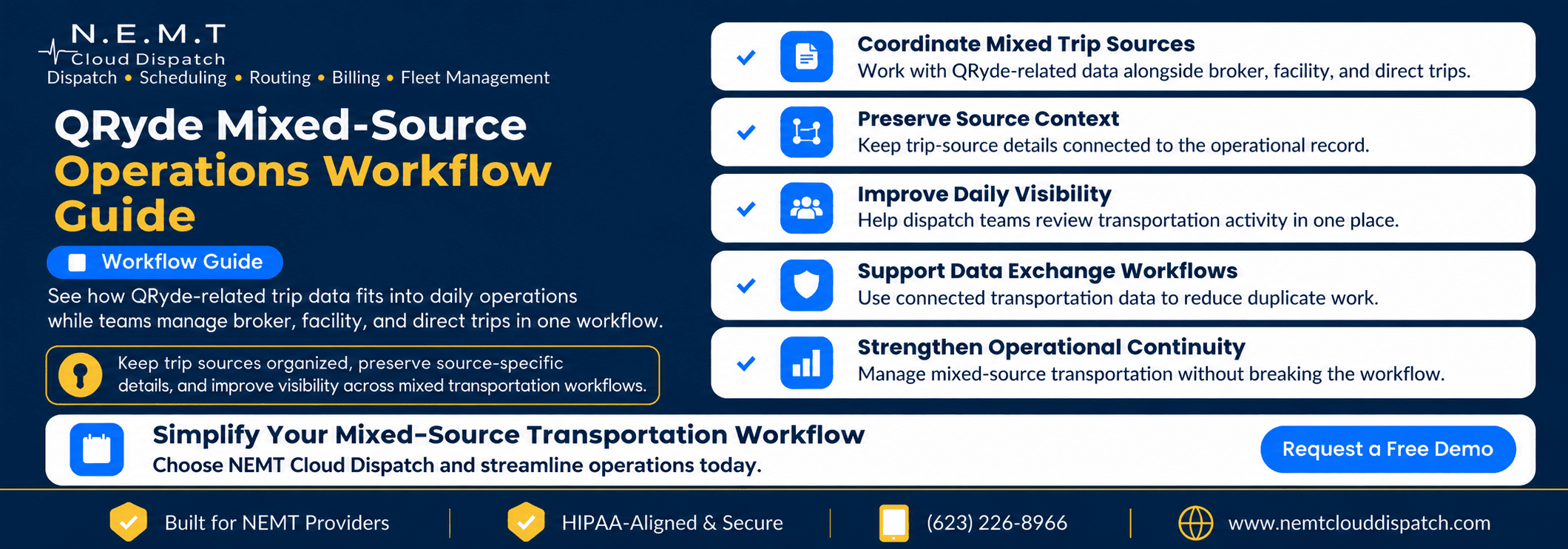
QRyde operations workflow helps NEMT providers turn supported transportation data into information dispatch teams can use throughout the day. The operational value appears when QRyde-related information reaches scheduling, dispatch, trip completion, and downstream processes.
A growing NEMT company may manage direct broker trips, facility requests, private-pay rides, recurring transportation, and QRyde-related transportation at the same time. Dispatch still needs to know which trips need attention, what changed, who can handle the work, and what happens after completion.
NEMT Cloud Dispatch supports QRyde data exchange separately from its seven direct broker integrations. A clear QRyde operations workflow helps teams use that supported data without confusing QRyde with a direct broker connection.
How a QRyde Operations Workflow Fits Daily Dispatch
NEMT Cloud Dispatch maintains direct integrations with Modivcare, MTM, Kaiser Permanente, VectorCare, Access2Care, Alivi, and HBSS Connect Corp. QRyde is supported separately as a software-platform data exchange connection.
A direct broker integration is built around a broker-specific relationship. QRyde is a transportation software platform, so providers should treat the connection as supported data exchange rather than an eighth direct broker integration.
Providers can review the NEMT Broker Integrations page for current connectivity information.
Once supported QRyde-related data reaches the operating environment, the dispatcher still has to manage the ride. A well-structured QRyde operations workflow makes that handoff easier while preserving the trip’s original source.
Example: One Provider, Several Transportation Sources
Imagine an operator starting the day with:
- Modivcare trips
- MTM trips
- Facility transportation requests
- Private-pay rides
- Recurring medical transportation
- QRyde-related transportation
The dispatcher should not have to treat these as six separate workdays. At the same time, the source of each trip may affect references, documentation, updates, billing, or follow-up.
The QRyde operations workflow gives the team a repeatable way to coordinate QRyde-related transportation with the broader schedule while keeping the source context available.
Step 1: Keep the Trip Source Visible
Integration should simplify operations without making every external trip look identical.
When supported transportation information enters NEMT Cloud Dispatch, operations staff may still need to know where the record originated and which external workflow it belongs to.
Strong QRyde trip source management helps staff distinguish a QRyde-related trip from a direct broker trip, facility request, or manually entered ride. That context matters when a trip changes, a reference needs verification, or downstream work depends on the original source.
The NEMT Broker Management Software page explains how NEMT Cloud Dispatch supports transportation from multiple external sources while keeping source-specific context connected to operations.
Step 2: Confirm the Supported Exchange Scope
A dependable QRyde operations workflow starts with a clear understanding of what the connection supports.
Public product information confirms QRyde data exchange support, but it does not publish a universal field-by-field specification for every implementation. Before go-live, the provider and implementation team should confirm:
- Which trip fields are supported
- Which system is the source of record for each field
- Which information moves into NEMT Cloud Dispatch
- Whether supported updates can move back
- How changes and cancellations are handled
- How duplicate records are prevented
- Which credentials or access requirements apply
- How testing is completed before launch
This prevents staff from assuming that every field or status automatically moves in both directions.
Step 3: Review the Trip Before Assignment
Data exchange is only useful when the incoming record is ready for transportation operations.
The team may need to confirm pickup and drop-off locations, requested times, mobility requirements, rider details, source references, and other information that affects assignment.
The NEMT Dispatch Platform gives operations teams a centralized environment for reviewing trips, drivers, vehicles, schedules, and exceptions.
Within a QRyde operations workflow, supported information enters the operating environment first. Dispatchers then use that information to make real transportation decisions.
Step 4: Move the Trip Into the Broader Dispatch Queue
The dispatcher’s job is not to manage an integration. The dispatcher’s job is to manage transportation.
Once a trip is ready, it needs to fit into the provider’s broader day. Staff may evaluate driver availability, vehicle suitability, schedule conflicts, trip timing, mobility requirements, and exceptions that need immediate attention.
QRyde-related transportation can be considered alongside other work without forcing staff to rebuild the same trip manually in a disconnected process.
Step 5: Preserve Source Context Through Execution
A trip can join the main dispatch queue without losing its origin.
Staff may still need source details when they review a change, resolve a duplicate, check a reference, investigate an exception, or determine what should happen after completion.
This approach supports a stronger NEMT transportation data handoff. The ride can move through scheduling, assignment, dispatch, and completion while the operations team still understands where the information came from.
A consistent QRyde operations workflow therefore connects two needs: one usable daily operation and clear source awareness.
Step 6: Handle Changes Without Creating Duplicate Work
External transportation data may change after the original record enters the workflow.
A pickup time may move. A destination may change. A trip may be canceled. A new note or external update may require staff attention.
Clear ownership rules matter. Teams should know which system controls each supported field and whether a change requires automatic processing, staff review, or manual action.
This is one of the practical benefits of NEMT software data integration: supported information can reduce repetitive data entry while the provider still maintains control over exceptions and conflicting records.
Clear ownership rules also reduce the chance that two versions of the same trip are worked independently.
Step 7: Define the Handoff After Completion
Completion is not always the end of the transportation record.
A finished trip may continue into billing, reporting, service review, reconciliation, or another downstream process. The correct handoff can depend on the source and the supported connection.
A useful operational chain looks like this:
Supported QRyde data → Source retained → Dispatcher review → Assignment → Execution → Completion → Downstream handoff
The QRyde operations workflow keeps the data exchange connected to the work transportation teams actually perform instead of treating the connection as a stand-alone technical feature.
What Dispatchers Need After QRyde Data Arrives
Dispatchers do not need every technical detail behind the connection, but they do need clear answers to operational questions:
- Where did this trip come from?
- Is the trip ready for assignment?
- Has anything changed since the last review?
- Does anything require manual attention?
- Which driver and vehicle can handle it?
- Does another trip create a conflict?
- What should happen after the ride is completed?
A strong QRyde transportation operations process answers those questions through a defined daily workflow.
That is where interoperability becomes practical. It is not only about moving information between systems. It is about making that information usable by the people responsible for delivering transportation.
The Federal Transit Administration’s mobility data interoperability research examines how mobility services exchange and use transportation data and provides broader context for why interoperability matters.
Why a QRyde Operations Workflow Supports Growth
As trip volume and partner relationships grow, it becomes harder to remember which rides came from which system.
A provider may simultaneously manage transportation from brokers, healthcare facilities, private-pay riders, recurring schedules, and external software connections. The QRyde operations workflow gives teams a consistent process for handling QRyde-related transportation without splitting the entire dispatch operation into separate environments.
QRyde’s official NEMT provider solutions describe scheduling, operations, billing, driver, and transportation-data capabilities within the QRyde platform. Providers using both systems should confirm which information is supported through their specific NEMT Cloud Dispatch connection.
Frequently Asked Questions
What Is QRyde Data Exchange Support in NEMT Cloud Dispatch?
NEMT Cloud Dispatch supports data exchange with the QRyde transportation software platform. QRyde is separate from the seven direct NEMT broker integrations. A QRyde operations workflow describes how supported QRyde-related information can move into day-to-day transportation operations after it reaches the working environment.
How Does QRyde Data Exchange Differ From Direct Broker Integration?
Direct broker integrations connect NEMT Cloud Dispatch with supported broker relationships and broker-specific workflows. QRyde is a transportation software platform supported through data exchange rather than another direct broker integration.
Can Operators Manage Trips From Multiple Transportation Sources?
Yes. NEMT Cloud Dispatch supports operations involving multiple brokers, facilities, private-pay transportation, recurring rides, manually managed trips, and supported external-system connections.
Which Trip Data Can Be Exchanged Through the Supported Connection?
Supported fields, mappings, direction, and synchronization behavior should be confirmed for the specific implementation. Providers should review the technical scope with the NEMT Cloud Dispatch product or implementation team before relying on a particular field or update behavior.
What Technical Requirements Apply to QRyde Data Exchange?
Requirements can vary by implementation. Providers should confirm credentials, access requirements, source-of-record rules, mappings, testing, duplicate handling, and supported change behavior before go-live.
How Can Transportation Data Interoperability Reduce Duplicate Work?
When supported information moves between systems, staff may not need to recreate the same transportation data manually. Clear ownership and handoff rules still matter so teams know when information can move through the connection and when staff review is required.
Connect the QRyde Operations Workflow to Daily Transportation
The greatest value from transportation interoperability appears when it improves daily operations.
The QRyde operations workflow gives NEMT providers a structured way to receive supported QRyde-related information, preserve its source, review it, work it alongside other transportation, and carry the trip through assignment, execution, completion, and downstream handoff.
NEMT Cloud Dispatch brings scheduling, dispatching, routing, driver management, billing, broker workflows, facility transportation, and reporting into one cloud-based operating environment.
A consistent QRyde operations workflow helps teams keep QRyde-related transportation connected to that broader operation without treating QRyde as another direct broker.
If your organization uses QRyde and wants to understand how supported data exchange can fit into your transportation operation, Request a Demo and ask about QRyde data exchange support.