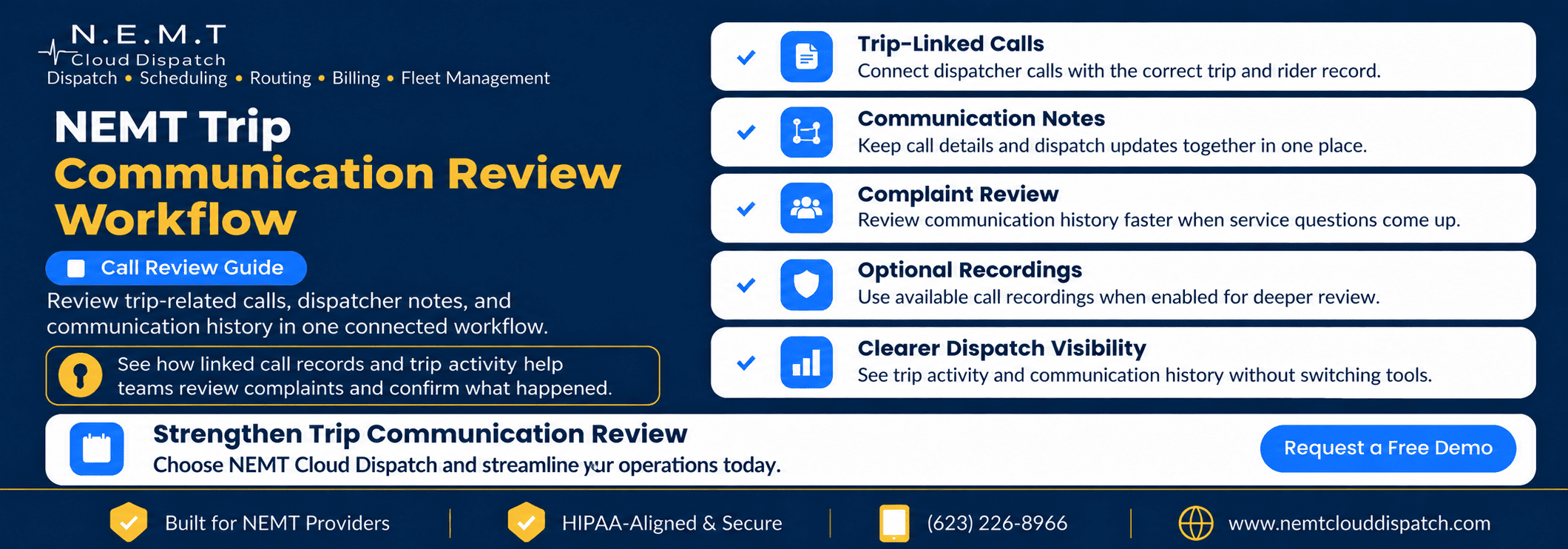
A NEMT trip communication review workflow gives transportation teams a practical way to reconstruct what happened when a rider, driver, facility, or broker questions a trip. Instead of relying on memory, staff can review the trip record alongside call activity, dispatcher notes, status changes, and an available recording when recording is enabled and lawfully retained.
Imagine a rider saying, “Dispatch told me my pickup would be at 7:45 a.m., but the vehicle came later.” The trip record shows one scheduled time, but the rider remembers another. The useful question is not who is wrong. It is what the available records show.
NEMT Cloud Dispatch helps teams review transportation activity and communication in the same operating environment so they can build a clearer timeline before responding.
Why a NEMT Trip Communication Review Workflow Matters
A NEMT trip may involve several conversations before the ride is complete. A dispatcher may call the rider about a pickup window, contact the driver about a delay, speak with a facility about an appointment change, or communicate with a broker about an exception.
This process gives supervisors a repeatable way to compare those conversations with the transportation record instead of searching unrelated phone logs or asking employees to remember details from a busy shift.
A useful review may include:
- The original scheduled pickup time
- Changes made after the reservation
- Incoming and outgoing call timestamps
- Dispatcher notes
- Driver status updates
- SMS or app communication when available
- Optional call recordings when enabled and lawfully retained
- The final trip outcome
Scenario: A Rider Reports the Wrong Pickup Time
Suppose a rider has a 9:00 a.m. medical appointment. After the trip, the rider says a dispatcher told them the vehicle would arrive at 7:45 a.m. The transportation record shows a different pickup time. Another dispatcher managed the ride later that morning, and a supervisor now needs to understand what happened.
Without a connected process, the team may have to search a separate phone system, identify the dispatcher, compare notes and timestamps, and rely on recollection.
With a NEMT trip communication review workflow, staff can begin with the trip and work outward through the available communication evidence.
Step 1: Identify the Correct Trip Before Reviewing Calls
The first step is confirming the exact trip involved in the complaint.
The trip record can provide the rider, locations, appointment time, planned pickup, assigned driver, trip status, changes, exceptions, and relevant notes. This matters when a rider has recurring transportation or several calls on the same day.
The NEMT Dispatch Platform gives dispatch teams a centralized view of trips, drivers, vehicles, exceptions, and communication activity. Starting with the right trip prevents staff from reviewing a call without knowing which transportation event it relates to.
The NEMT trip communication review workflow starts with one transportation record, not a general phone log.
Step 2: Compare the Original Schedule With Later Changes
Communication complaints often make more sense after staff review how the trip changed. A facility may reschedule an appointment, a driver may be reassigned, or dispatch may change the pickup window.
Before reviewing phone activity, note:
- The original scheduled pickup
- Any later time changes
- Who made the change
- When the change occurred
- Any driver or vehicle reassignment
- Status updates surrounding the change
This gives the NEMT trip communication review workflow a transportation baseline. Staff can then compare calls and notes with the sequence of operational changes.
Step 3: Review Trip-Related Call Activity
NEMT Cloud Dispatch offers integrated VoIP as an optional add-on module. Its communication tools include click-to-call, call history, call notes, and call logs that can be associated with relevant trip or driver records.
During a complaint review, staff need to know when a call occurred and what was happening with the trip at that time.
A NEMT trip communication timeline might show:
- 7:12 a.m. — outbound call to the rider
- 7:18 a.m. — dispatcher note added
- 7:31 a.m. — driver reassigned
- 7:40 a.m. — outbound call to the replacement driver
- 8:02 a.m. — driver marked en route
This is where the NEMT trip communication review workflow becomes more useful than a stand-alone recent-calls list because the call activity has transportation context.
For broader phone-system capabilities, see NEMT VoIP Software.
Step 4: Read Dispatcher Notes in Context
Call notes can explain why a later operational decision was made. A dispatcher may note that the rider requested additional time, a facility changed the appointment, the pickup entrance moved, or the driver reported a delay.
During a NEMT complaint communication review, staff should read notes beside the trip timeline rather than treating them as isolated text. A note entered at 7:18 a.m., for example, may explain a pickup-time change made two minutes later.
Those notes become part of the broader evidence trail and help another dispatcher understand why a decision was made.
Step 5: Review an Available Recording When Appropriate
If call recording was enabled and the relevant recording is available, it can provide additional context.
NEMT Cloud Dispatch supports call recording through its optional VoIP module. Providers should configure and use recording in accordance with applicable federal, state, and local requirements concerning notice, consent, retention, access, and use.
Staff should compare a recording with the trip record, timestamps, dispatcher notes, driver events, and operational changes.
The NEMT trip communication review workflow remains useful even when no recording is available because staff can still use trip history, call activity, notes, and status events.
If recorded communication includes electronic protected health information, regulated organizations should apply appropriate safeguards. The HHS HIPAA Security Rule summary provides guidance on protecting electronic protected health information.
Step 6: Reconstruct the Communication Timeline
Once the relevant records are collected, place them in chronological order.
A NEMT trip communication review workflow can follow this sequence:
- Confirm the original trip details.
- List relevant schedule or assignment changes.
- Review incoming and outgoing call timestamps.
- Read dispatcher notes connected to the communication.
- Compare driver status updates.
- Review an available recording if enabled and appropriate.
- Note the final pickup, drop-off, cancellation, or other trip outcome.
- Document the conclusion.
This helps a supervisor determine what information was available at each point in the trip.
Step 7: Document the Resolution
Once the timeline is clear, record the outcome of the internal review.
Useful NEMT transportation dispute records may include:
- The trip reviewed
- The reported issue
- Relevant communication timestamps
- Important call notes
- Applicable driver status events
- A recording reference when available
- The review conclusion
- Follow-up action
The NEMT trip communication review workflow should end with a clear resolution record. That helps if the complaint is raised again or reviewed later.
How the NEMT Trip Communication Review Workflow Helps During Shift Changes
A morning dispatcher may speak with the rider and update the trip. An afternoon dispatcher may handle the return ride. If the reason for a change exists only in the first dispatcher’s memory, the next employee starts with incomplete information.
The NEMT Driver App supports driver-dispatch communication, while the Dispatch Platform keeps trip activity available to the operations team.
A consistent NEMT trip communication review workflow helps the next dispatcher understand the sequence without restarting the investigation.
Where Integrated VoIP Fits
Integrated VoIP supports the communication side of the process, but the review is broader than the phone system.
The VoIP module can provide click-to-call, contact lists, call history, notes, and recording capabilities. The trip record provides the transportation context.
The NEMT trip communication review workflow brings those sources together when staff need to understand a disputed ride.
VoIP is available as an optional add-on module. Pricing can depend on call volume and concurrent lines, so providers should confirm current pricing with NEMT Cloud Dispatch.
Frequently Asked Questions
Does NEMT Cloud Dispatch Offer an Integrated Phone System?
Yes. NEMT Cloud Dispatch offers integrated VoIP as an optional add-on module. It supports calling from the dispatch environment along with call history, notes, and recording capabilities.
Can Calls Be Linked to Trip Records?
Yes. Relevant call logs can be associated with the trip or driver records they relate to, giving staff more context when reviewing transportation activity.
Does the Platform Support Optional Call Recording?
Yes. Call recording is available through the VoIP module. Providers should configure recording according to applicable notice, consent, privacy, retention, and access requirements.
How Can Call History Help With Transportation Complaints?
Call timestamps, dispatcher notes, trip changes, driver status events, and available recordings can help staff reconstruct the sequence surrounding a complaint. A NEMT trip communication review workflow organizes those records around the transportation issue being reviewed.
Can Dispatchers Contact Drivers Directly From the Platform?
Yes. NEMT Cloud Dispatch supports integrated VoIP calling and driver-app communication. The appropriate channel can depend on the situation and provider configuration.
Is VoIP Included in the Base Subscription or Priced Separately?
NEMT Cloud Dispatch describes VoIP as an optional add-on module. Pricing can depend on call volume and concurrent lines, so providers should confirm current pricing when evaluating the module.
Turn a Complaint Into a Clear Communication Timeline
A rider complaint should not force the team to rely on memory or search disconnected systems.
A NEMT trip communication review workflow gives NEMT operators a structured way to identify the correct ride, compare schedule changes, review call activity, read dispatcher notes, check driver updates, use an available recording when appropriate, and document the resolution.
NEMT Cloud Dispatch connects communication tools with transportation operations so teams can review a disputed trip in context.
When the process is consistent, the NEMT trip communication review workflow can improve shift handoffs, complaint reviews, and follow-up communication by giving staff one clear sequence of transportation events.
If your organization wants a clearer way to review trip-related communication and investigate service questions, Request a Demo and explore the integrated NEMT communication tools available through NEMT Cloud Dispatch.