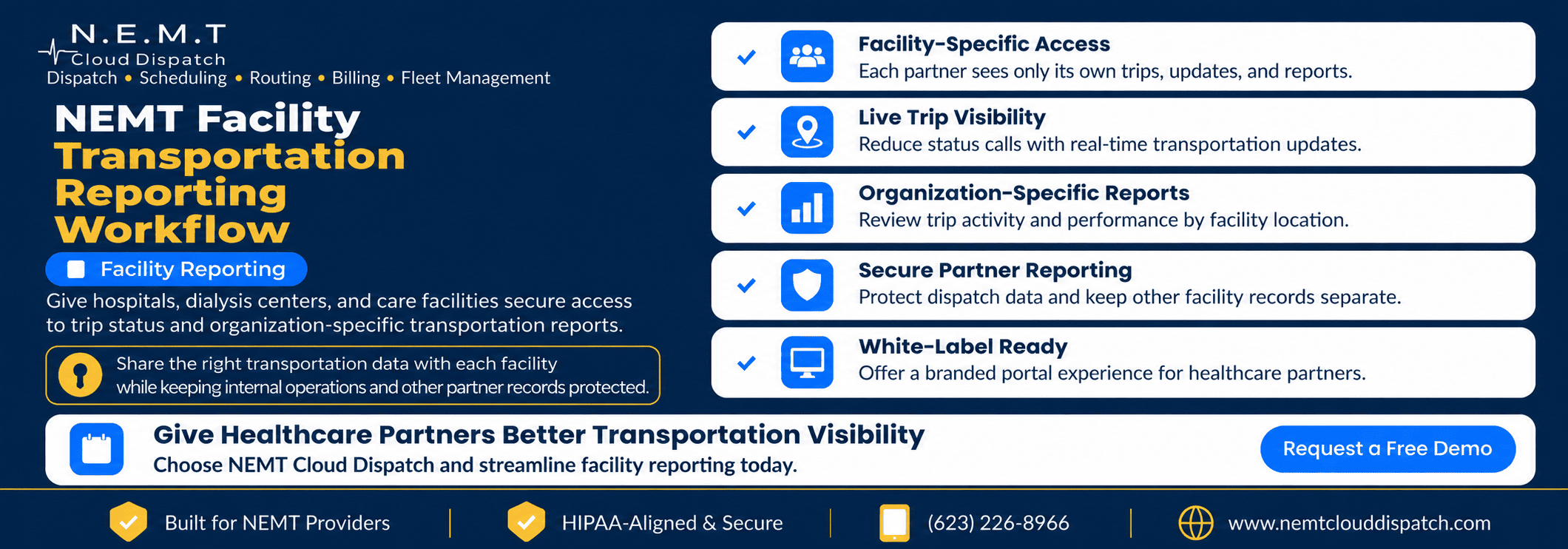
NEMT facility reporting workflow helps transportation providers turn one centralized operation into clear, separate reporting for every healthcare partner they serve. A hospital, dialysis center, skilled nursing facility, and outpatient clinic may all use the same NEMT provider, but each organization needs a view limited to its own transportation activity.
As an NEMT company grows, the provider may manage thousands of rides across facilities, brokers, and other accounts. Internal dispatch needs the full operating picture; each healthcare partner needs only its own trips, status updates, and performance information.
NEMT Cloud Dispatch keeps the provider’s broader operation centralized while supporting organization-scoped access for facility partners. A structured NEMT facility reporting workflow turns shared operational data into focused transportation reporting without giving each partner access to the provider’s entire dispatch environment.
How the NEMT Facility Reporting Workflow Separates Partner Data
The process begins by keeping every trip connected to the organization that requested it.
When a healthcare facility submits transportation, the trip enters the provider’s central operating environment. Dispatch may assign a driver, coordinate a vehicle, monitor the ride, respond to exceptions, and complete the trip alongside transportation from many other accounts.
A reliable NEMT facility reporting workflow follows a simple path:
Facility request → Central trip record → Dispatch operation → Trip completion → Facility grouping → Partner-specific reporting
That structure lets the NEMT provider manage one transportation operation while creating different reporting views for different healthcare partners.
Step 1: Keep the Facility Connected to the Trip Record
Accurate facility reporting starts when the ride is created.
The trip record should retain the healthcare organization associated with the transportation along with the rider, pickup and drop-off locations, requested time, mobility needs, and other operational information.
This makes NEMT facility trip reporting easier because staff do not have to determine the originating facility after the rides are completed.
For example, imagine a provider completes 3,000 trips in one month:
- 420 belong to Hospital A
- 310 belong to Dialysis Center B
- 185 belong to Dialysis Center C
- 260 belong to Skilled Nursing Facility D
- The remaining trips belong to other facilities, brokers, and accounts
The provider needs the complete 3,000-trip operating picture. Hospital A only needs its own transportation activity.
Keeping facility identity attached to the trip reduces the need to reconstruct partner reports from spreadsheets later.
Step 2: Manage Trips Centrally Without Sharing the Internal Dispatch View
Healthcare partners need transportation visibility, but they do not need every detail available to an internal dispatcher.
NEMT Cloud Dispatch lets providers manage active trips through the NEMT Dispatch Platform, where operations teams work with drivers, vehicles, schedules, exceptions, and trip status.
Facility staff may only need to know whether a ride is scheduled, whether a driver has been assigned, whether the rider has been picked up, and whether transportation was completed.
The NEMT facility reporting workflow separates those perspectives. Dispatch keeps the broader operating view, while partner-facing information stays focused on the trips associated with that facility.
That gives healthcare partners useful visibility without making them internal dispatch users.
Step 3: Turn Central Trip Activity Into Facility-Level Reports
The value becomes clear when operational trip records turn into information a healthcare partner can use.
Depending on configuration, NEMT healthcare partner reports may include:
- Number of requested trips
- Completed transportation
- Recurring ride volume
- On-time service trends
- Cancellations and no-shows
- Trip status history
- Transportation volume over time
- Relevant billing information where configured
A NEMT facility reporting workflow makes those reports more useful than a generic trip export because each partner sees activity connected to its own organization.
Healthcare organizations can also use the NEMT Facility Portal to request transportation and monitor trips associated with their organization.
Step 4: Keep One Facility’s Reporting Separate From Another
Multi-facility transportation requires clear information boundaries.
A dialysis coordinator at one center should not receive another dialysis center’s transportation history. A hospital should not see a skilled nursing facility’s riders simply because the same NEMT company serves both organizations.
That makes NEMT facility data separation important.
NEMT Cloud Dispatch supports facility-specific users and organization-scoped trip views, allowing authorized partners to work with transportation information tied to their own organization.
A well-structured NEMT facility reporting workflow keeps partner reports aligned with the correct facility instead of mixing transportation activity across organizations.
The U.S. Department of Health and Human Services explains in its HIPAA minimum necessary guidance that covered entities generally should take reasonable steps to limit protected health information to what is necessary for the intended purpose. Providers should configure access according to applicable legal, contractual, and operational requirements.
Step 5: Use the Same Records for Partner Performance Reviews
Reports are more useful when the NEMT provider and healthcare partner can discuss transportation performance from consistent records.
NEMT partner performance reports can create a shared operational reference instead of separate spreadsheets.
A monthly review might ask:
- How many rides did the facility request?
- How many were completed?
- Where are delays or exceptions occurring most often?
- Are certain pickup windows creating recurring problems?
- Is transportation demand increasing or decreasing?
- Which recurring trips may need adjustment?
The NEMT facility reporting workflow helps move those conversations away from isolated status questions and toward measurable service patterns.
The goal is to give the healthcare partner enough information to understand its transportation without exposing the full dispatch operation.
Step 6: Apply the Same Reporting Model Across Multiple Facilities
Reporting becomes harder as an NEMT company adds healthcare partners.
One facility may be manageable with a spreadsheet. Ten, twenty, or fifty partners make manual reporting much harder.
NEMT multi-facility reporting allows one transportation operation to support many partner relationships without mixing their reporting views.
A provider may centrally manage:
- Hospital discharge transportation
- Recurring dialysis rides
- Skilled nursing facility appointments
- Rehabilitation transportation
- Outpatient clinic visits
- Behavioral health transportation
Each trip remains part of the provider’s overall operation while also contributing to the correct partner’s reporting.
That is how a NEMT facility reporting workflow can scale without requiring a separate dispatch system or manually maintained report for every healthcare facility.
Example: Reporting for a Dialysis Center
Recurring dialysis transportation is a practical example of why facility-level reporting matters.
A dialysis center may coordinate rides several times each week for the same group of patients. Staff may want to know whether pickups are consistently on time, whether return transportation is being completed, and whether recurring service patterns need attention.
The provider still manages those trips alongside the rest of its operation. However, NEMT facility trip reporting can give the dialysis center a focused view of its own transportation instead of a report containing every dialysis trip the provider performs.
Authorized facility users can monitor relevant trip activity while the provider manages operations internally.
For more detail about recurring dialysis operations, see the California Dialysis NEMT Scheduling Guide.
Why the NEMT Facility Reporting Workflow Supports Growth
Every additional hospital, dialysis center, rehabilitation facility, or skilled nursing facility adds another relationship that may require trip status, transportation history, service reviews, and performance reporting.
The NEMT facility reporting workflow allows those relationships to grow while one provider continues managing scheduling, dispatching, drivers, vehicles, billing, and exceptions centrally.
Reporting can then be organized around the healthcare organization associated with each trip. This keeps partner visibility controlled and relevant even as the provider adds more facility relationships.
Where the Facility Portal Fits
The facility portal supports the partner-facing side of the relationship.
Authorized healthcare staff can submit transportation requests and track relevant trips. The broader Facility & District Portals capability supports organization-scoped access, real-time status, role-based permissions, organization-specific reporting, and configurable partner experiences.
The portal is the access point. The NEMT facility reporting workflow turns centrally managed trip information into meaningful partner-specific transportation reporting.
White-label options can also support a branded facility experience.
Frequently Asked Questions
What Information Can Healthcare Partners View Through the Facility Portal?
Authorized facility users can access transportation information associated with their organization based on permissions and configuration. This may include trip requests, current trip status, completed transportation, and relevant organization-specific reporting.
Can Hospitals Track Patient Transportation Without Calling Dispatch?
Yes. Authorized hospital staff can use the NEMT Facility Portal to monitor transportation associated with their organization, reducing routine trip-status calls to dispatch.
Can Facilities Get Reports for Their Own Trips?
Yes. The NEMT facility reporting workflow keeps facility identity connected to transportation records so authorized partners can work with reports focused on their own trips rather than the provider’s entire operation.
How Does the NEMT Facility Reporting Workflow Keep Facility Data Separate?
NEMT Cloud Dispatch supports organization-scoped access and individual facility users. The NEMT facility reporting workflow allows the provider to manage multiple partners centrally while keeping each facility’s transportation view tied to its organization and permissions.
Can Dialysis Centers Use the Portal for Transportation Coordination?
Yes. Dialysis centers can use facility-facing workflows to arrange recurring transportation and monitor relevant pickup and drop-off activity. The NEMT provider continues managing drivers, vehicles, schedules, and exceptions through its internal operational tools.
Does NEMT Cloud Dispatch Support White-Labeled Facility Portals?
Yes. NEMT Cloud Dispatch supports configurable, white-labeled facility portal experiences so providers can offer branded partner access while maintaining organization-specific transportation views.
Give Every Healthcare Partner the Right Transportation View
A growing NEMT provider should not have to choose between keeping healthcare partners informed and exposing the entire dispatch operation.
A structured NEMT facility reporting workflow keeps transportation centralized for the provider while separating partner reporting by organization. Hospitals can review their transportation. Dialysis centers can review theirs. Skilled nursing facilities can work with their own activity.
The provider keeps one operating environment while each partner receives the transportation view that matters to its organization.
NEMT Cloud Dispatch connects facility relationships with scheduling, dispatching, trip management, driver workflows, billing, and reporting while maintaining clear partner-level boundaries.
If your organization wants to give healthcare partners clearer transportation visibility without manually preparing separate spreadsheets or exposing unrelated trip data, Request a Demo and see the Healthcare Facility Portal in action.