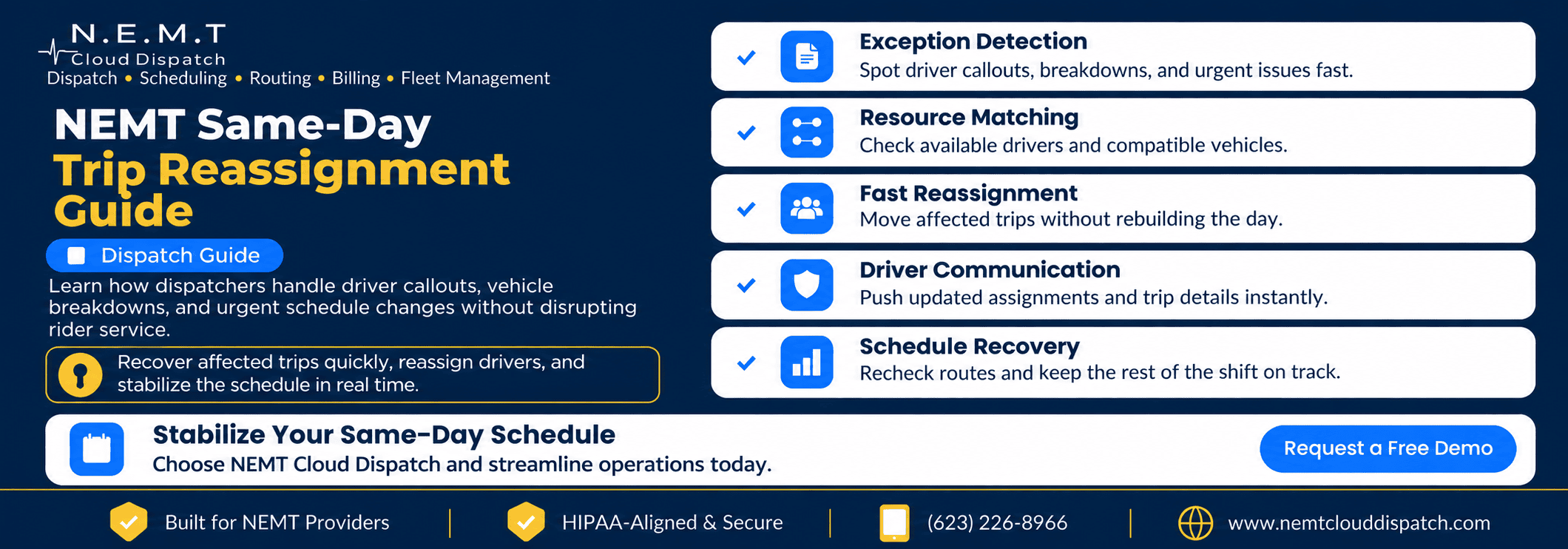
NEMT same-day trip reassignment gives dispatchers a structured way to recover when a driver calls out, a vehicle breaks down, or an urgent schedule change puts multiple rides at risk. Instead of rebuilding the day in a spreadsheet or relying on a long phone tree, dispatch can identify affected trips, review compatible resources, move assignments, notify drivers, and stabilize the remaining schedule from one operating view.
A same-day disruption rarely affects only one ride. One unavailable driver may have several upcoming pickups. One wheelchair-accessible vehicle going out of service may affect multiple riders with mobility requirements.
NEMT Cloud Dispatch helps transportation teams respond with live trip, driver, vehicle, and exception visibility. The goal of NEMT same-day trip reassignment is not simply to move a trip. It is to recover the schedule without creating another problem later in the shift.
Same-Day Recovery Begins With the Exception
A callout, breakdown, late start, cancellation, traffic delay, or urgent trip addition can change a schedule that looked stable minutes earlier.
The first task is to identify what changed and what the change affects. The NEMT Dispatch Platform brings active trips, drivers, vehicles, and exceptions into one real-time environment.
A practical NEMT dispatch recovery workflow follows a simple sequence:
Detect → Assess → Match → Reassign → Notify → Recheck → Monitor
That sequence gives NEMT same-day trip reassignment a repeatable structure and helps dispatch protect pickup windows, rider requirements, and the rest of the day.
Scenario: A Wheelchair Van Breaks Down Mid-Shift
Consider a busy morning. A wheelchair-accessible van has three remaining assignments:
- A dialysis pickup in 25 minutes
- A specialist appointment later in the morning
- A return trip after the appointment
The driver reports a mechanical issue, and the vehicle must be taken out of service.
This is a classic NEMT trip reassignment after vehicle breakdown scenario. The nearest available driver cannot automatically take all three rides. The replacement must match rider requirements, fit the time windows, and leave enough capacity for the rest of the driver’s workload.
Step 1: Identify Every Trip Affected by the Disruption
The dispatcher first needs to see which upcoming rides are tied to the unavailable driver or vehicle.
For NEMT same-day trip reassignment, the immediate questions include:
- Which trips have not started?
- Which rides are already in progress?
- Which pickups have the tightest appointment windows?
- Which riders have wheelchair, escort, or specialty requirements?
- Which later assignments could also be affected?
This prevents a common recovery mistake: fixing the first urgent pickup while overlooking downstream trips tied to the same resource.
NEMT Cloud Dispatch exception visibility helps the team separate rides that need attention from rides that can continue as planned.
Step 2: Review Available Drivers and Vehicles
After the affected trips are clear, dispatch can review available resources.
Availability means more than an empty slot. A driver may be nearby but already committed to another pickup. A vehicle may be available but unsuitable for a rider who requires wheelchair securement or additional capacity.
A strong NEMT same-day driver callout response considers:
- Current driver location
- Existing trip load
- Upcoming pickups
- Vehicle type and capacity
- Driver qualifications
- Rider-specific requirements
- Travel time to the pickup
During NEMT same-day trip reassignment, the best replacement is the resource that can complete the affected ride without creating a new service failure elsewhere.
Step 3: Confirm Driver and Vehicle Compatibility
When time is tight, the closest vehicle can look like the easiest solution. It is not always the correct one.
Before committing NEMT same-day trip reassignment, dispatch should confirm that the replacement driver and vehicle match the requirements already attached to the trip.
A wheelchair rider may need an accessible vehicle with usable securement capacity. Another trip may involve an escort, a driver qualification, or a specialty note.
NEMT Cloud Dispatch can help dispatchers evaluate compatibility during reassignment. For more detail, see NEMT Vehicle Assignment Mistakes.
Step 4: Reassign the Trip Without Rebuilding It
Once dispatch identifies a suitable replacement, the reservation should move while its original information remains intact.
The trip should keep its rider details, pickup and drop-off addresses, appointment time, broker or account source, mobility requirements, and trip notes.
That continuity is what makes NEMT same-day trip reassignment practical. Dispatch changes the assigned resource without recreating the reservation or losing the details the next driver needs.
The NEMT Route Optimization Software can support real-time route adjustments when drivers call out, brokers add trips, or operating conditions change.
Step 5: Send the Updated Assignment to the Driver
A reassignment is not complete when the dispatch board changes. The replacement driver needs the updated trip information in time to act.
The NEMT Driver App gives drivers access to manifests, pickup and drop-off details, rider notes, route information, and communication with dispatch.
During NEMT same-day trip reassignment, dispatch may also need to communicate a changed sequence, a tight pickup window, or a rider-specific instruction.
Step 6: Recheck the Remaining Schedule
Moving one trip to another driver changes that driver’s day. Dispatch should immediately review the replacement driver’s remaining assignments and the trips left behind by the unavailable resource.
NEMT same-day trip reassignment may require the team to:
- Reorder upcoming pickups
- Shift another ride to a different driver
- Move a compatible trip to another vehicle
- Account for updated travel time
- Protect a high-priority appointment window
- Watch for a conflict created by the change
A NEMT same-day schedule recovery succeeds when the revised plan works as a whole, not merely when one trip receives a new driver.
Step 7: Monitor Until the Operation Is Stable
After the reassignment, dispatch should continue watching the affected rides.
The team should confirm that the replacement driver received the assignment, the pickup remains achievable, and the change has not placed later trips at risk.
NEMT disrupted trip recovery is complete only when the wider schedule is stable. For that reason, NEMT same-day trip reassignment should be treated as an active recovery process rather than a one-time click.
Driver Callout Scenario: Recovering the Remaining Shift
A driver callout before the shift can affect several rides at once.
Instead of moving every reservation to one replacement driver, dispatch can work through the remaining shift trip by trip. The most time-sensitive or constrained rides may need attention first.
A repeatable NEMT same-day driver callout response can follow these steps:
- Identify every unperformed trip.
- Prioritize rides by timing and rider requirements.
- Review eligible drivers and vehicles.
- Reassign compatible rides.
- Send updated manifests and instructions.
- Recheck each driver’s revised workload.
- Monitor the recovery plan.
This approach keeps NEMT same-day trip reassignment focused on the entire affected shift instead of treating each ride as an isolated problem.
When a New Trip Arrives During the Recovery
Sometimes new work arrives while dispatch is already recovering from a callout or breakdown.
A broker or facility may add an urgent trip. Dispatch then has to determine whether the new ride can fit into the revised schedule without destabilizing existing assignments.
The NEMT Scheduling Software supports same-day requests by helping teams consider driver availability, vehicle capacity, time windows, and specialty requirements.
During NEMT same-day trip reassignment, a new trip should be evaluated against the current recovery plan, not the schedule that existed before the disruption.
Why Real-Time Visibility Matters
A printed manifest shows what was planned. It cannot show that a driver called out five minutes ago or that a vehicle was just taken out of service.
NEMT Cloud Dispatch brings trip status, driver activity, vehicle information, exceptions, communication, and schedule changes into one operating environment. That visibility helps dispatchers make NEMT same-day trip reassignment decisions using current information.
For Medicaid transportation programs, dependable transportation supports access to covered care. The federal Medicaid Assurance of Transportation resource provides additional information about transportation requirements and beneficiary access.
Frequently Asked Questions
What happens when an NEMT driver calls out unexpectedly?
Dispatch identifies the remaining trips assigned to the unavailable driver, prioritizes affected rides, reviews compatible drivers and vehicles, reassigns trips, sends updated assignments, and checks the revised schedule for new conflicts.
Can NEMT Cloud Dispatch reassign trips to another driver?
Yes. NEMT Cloud Dispatch supports trip reassignment while preserving the reservation details already attached to the ride. NEMT same-day trip reassignment helps dispatchers move affected trips without recreating the reservation from scratch.
How does the system check driver and vehicle compatibility?
Dispatchers can compare trip requirements with available driver and vehicle information before committing a reassignment. Keeping rider requirements, vehicle capabilities, and driver qualifications current supports better matching decisions.
How are drivers notified about updated assignments?
Drivers can receive updated trip information through the NEMT Driver App. Dispatch can also use available communication tools to share time-sensitive assignment changes and operational notes.
Can dispatchers manage same-day broker trip additions?
Yes. Same-day trips can be evaluated against current driver availability, vehicle capacity, specialty requirements, and the active schedule before they are placed into the recovery plan.
How does real-time exception management help reduce disruption?
It gives dispatchers a visible view of callouts, vehicle problems, cancellations, delays, and other issues that require action. This supports NEMT same-day trip reassignment by helping the team identify affected rides and prioritize the next recovery decision.
Recover the Schedule, Not Just One Trip
A driver callout or vehicle breakdown can change the rest of the shift. The most effective response is a structured NEMT dispatch recovery workflow that moves from detection to stabilization.
NEMT same-day trip reassignment helps dispatchers identify affected rides, review compatible resources, move assignments, communicate changes, recheck the remaining schedule, and monitor the operation until it is stable.
NEMT Cloud Dispatch connects live dispatch, driver communication, vehicle information, route adjustments, scheduling, and exception visibility so transportation teams can respond when the day changes unexpectedly.
If your team wants a faster, more organized way to handle callouts, breakdowns, urgent trips, and disrupted schedules, Request a Demo and see real-time NEMT dispatch in action.