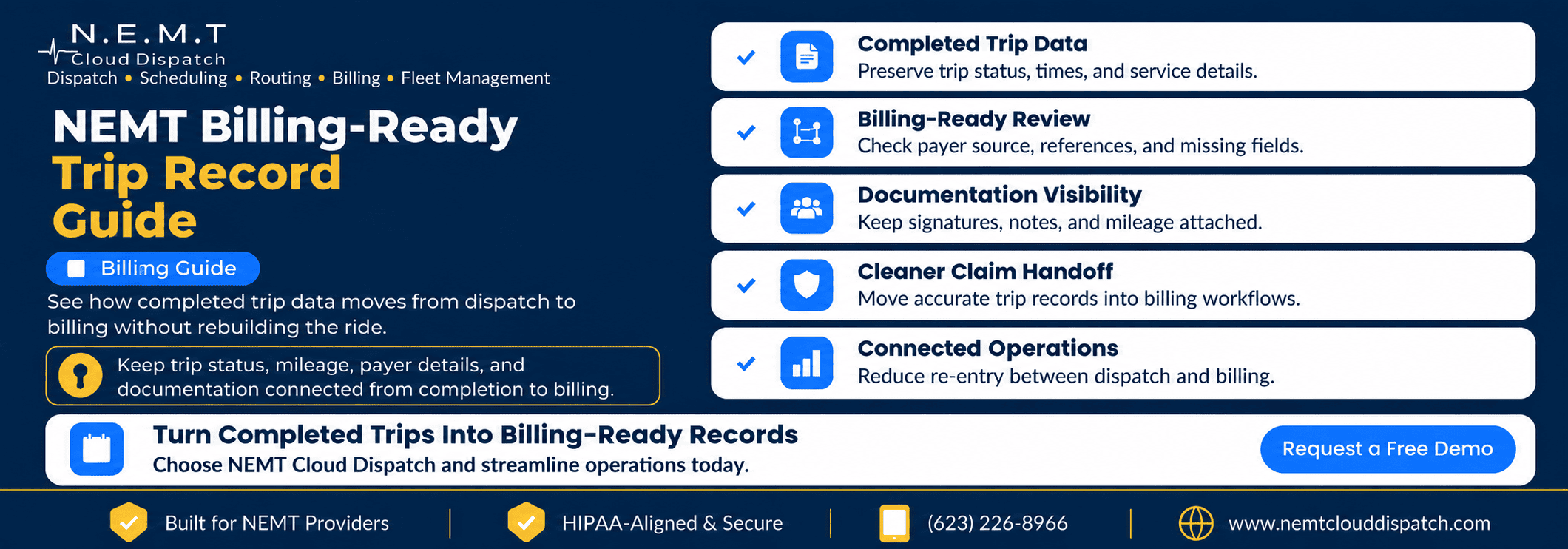
A NEMT billing-ready trip record gives billing staff a reliable view of what actually happened on a ride before claim preparation begins. A trip may be marked complete in dispatch, but billing still needs the correct rider, payer, service date, mileage, authorization, timing, and documentation tied to that ride.
NEMT Cloud Dispatch keeps those operational details connected from scheduling through completion. Instead of rebuilding a ride from driver messages, spreadsheets, portal screenshots, GPS tools, and separate billing files, staff can work from one record.
The key question is what information should remain attached to the trip so billing can begin with a trustworthy record.
Why Billing Readiness Starts Before Drop-Off
Billing readiness begins before the driver taps “Complete.”
When a reservation is created, the trip may already contain rider information, pickup and drop-off locations, appointment time, payer or broker source, transportation mode, authorization references, and mileage details. Dispatch adds the driver and vehicle assignment, while the driver contributes actual trip events.
By the end of the ride, the NEMT billing-ready trip record should show what was planned and what occurred.
For broader real-time operations, see the NEMT Dispatch Platform.
Step 1: Start With One Authoritative Trip Record
The cleanest workflow begins when operations and billing use the same record.
A trip record may include:
- Rider or member details
- Pickup and drop-off locations
- Requested date and time of service
- Payer, account, or broker source
- Transportation mode
- Authorization or broker reference, when applicable
- Planned trip legs
- Rate or mileage information, when relevant
If something changes, staff should update the working record instead of copying the change into a disconnected file. A strong NEMT billing-ready trip record starts with consistent data, not with a claim form.
Step 2: Let Driver Events Show What Actually Happened
The schedule describes the plan. Driver activity documents the service that occurred.
Depending on the workflow, the record may capture arrival, pickup, drop-off, completion, timestamps, mileage, signatures, GPS information, notes, or exceptions.
Billing should not have to assume the scheduled ride matches the completed ride. The NEMT billing-ready trip record should reflect the actual service history available in the system.
For deeper coverage of GPS-stamped pickup and drop-off records, timestamps, signatures, and proof of service, review the NEMT Trip Verification guide. The NEMT Driver App also supports mobile trip events and GPS-based proof of pickup and drop-off.
Step 3: Completion Creates a Billing-Readiness Checkpoint
A completed trip and a billing-ready trip are not always the same.
When a driver marks a ride complete, the record should be reviewed for operational completeness before it moves farther into the financial workflow.
A practical NEMT billing-ready trip record may contain:
- Final trip status
- Date of service
- Rider and payer information
- Broker or account source
- Authorization reference, when applicable
- Completed trip legs
- Pickup and drop-off details
- Driver and vehicle
- Actual service times
- Mileage, when applicable
- Required signatures or documents
- Cancellation, no-show, or exception notes when relevant
Requirements vary by payer, broker, Medicaid program, and contract. A complete operational record gives billing staff the information needed to apply the appropriate downstream requirements.
Step 4: Confirm the Completed Trip Record Is Billing-Ready
Operational completeness should be confirmed before claim preparation begins.
Before handing the trip to billing, staff can ask:
- Is the final trip status correct?
- Is the payer or broker source attached?
- Are all completed legs present?
- Does the service date match the performed ride?
- Is the authorization or broker reference present when required?
- Is mileage available when needed?
- Are required documents or signatures attached?
- Are unresolved exceptions clearly identified?
If something is missing, the trip can be held for correction before claim preparation. This review strengthens the NEMT billing-ready trip record before claim-level validation begins.
For claim-level preparation, validation, 837P, CMS-1500, and broker billing features, see NEMT Billing & Claims.
Step 5: Keep Payer and Broker Context Attached
Billing should not have to investigate who owns a completed trip after the ride is over.
If a trip originated from a facility account, Medicaid payer, private-pay source, or supported broker connection, that context should remain attached through completion. The NEMT billing-ready trip record should preserve that source instead of becoming a generic completed ride with no financial context.
This matters when providers handle multiple brokers or accounts with different billing and documentation rules.
For broader broker operations, see NEMT Broker Management Software.
Step 6: Hand the Complete Record to the Right Billing Workflow
Once the trip is ready for billing, the billing system can apply the appropriate downstream process.
NEMT Cloud Dispatch supports workflows that may include 837P electronic professional claims, CMS-1500 paper claim workflows, broker-specific billing outputs, and other supported formats depending on the payer and contract.
CMS describes the 837P as the standard electronic format used by health care professionals and suppliers to submit professional claims. CMS-1500 is the standard paper claim form used for professional claims when paper submission is allowed. Review the CMS Medicare Billing: CMS-1500 & 837P guide. X12 also documents the 837 Health Care Claim transaction.
Those standards govern downstream claim formats. The NEMT billing-ready trip record remains the operational source before those billing requirements are applied.
For detailed billing workflows, see NEMT Invoicing & Billing and NEMT Billing & Claims.
Step 7: Do Not Rebuild the Ride From Different Systems
A disconnected handoff creates unnecessary work.
Without a connected record, billing staff may have to compare dispatch notes, driver messages, GPS logs, broker portals, authorization files, mileage logs, signatures, paper forms, and separate billing applications.
With a NEMT billing-ready trip record, the billing team starts with one operational history and investigates true exceptions instead of reconstructing every ride. That can reduce duplicate data entry and give billing a clearer starting point.
One Trip-to-Billing Handoff in Eight Steps
1. Schedule
Create the trip with rider, payer, locations, timing, transportation mode, and applicable reference information.
2. Assign
Dispatch assigns the driver and vehicle while keeping the payer, broker, and trip source attached.
3. Perform
The driver carries out the ride and records supported trip events.
4. Complete
The system retains the actual service record, final status, and supporting details.
5. Review
Operations or billing checks whether the completed record contains the information needed for the next stage.
6. Mark Billing-Ready
A complete NEMT billing-ready trip record can now move into the appropriate financial workflow.
7. Prepare the Billing Output
The billing module applies the applicable payer, broker, claim, or invoice process.
8. Submit and Follow Up
Billing staff use the appropriate submission channel and handle payer-specific follow-up.
What Should Stay With the Trip Through Completion?
A strong handoff preserves information instead of copying it from system to system. The exact fields vary, but the NEMT billing-ready trip record should answer five questions clearly.
Who Received the Service?
The rider or member should remain connected to the correct account, payer, or broker context.
What Service Was Actually Completed?
The record should reflect the trip legs that were performed, not only the original schedule.
When and Where Did It Happen?
Service dates, trip events, pickup and drop-off locations, and relevant timestamps should remain available.
Who Performed the Ride?
The driver and vehicle used for the completed service should stay attached to the trip.
What Supporting Context Applies?
Authorization references, broker IDs, mileage, signatures, GPS data, and exception notes may matter depending on the payer and contract.
Together, these elements create a stronger NEMT billing-ready trip record for billing review.
How NEMT Cloud Dispatch Connects Operations With Billing Readiness
NEMT Cloud Dispatch brings scheduling, dispatch, driver activity, broker data, trip documentation, fleet information, and billing tools into one connected environment.
The advantage is continuity. Driver activity and payer or broker context remain connected after completion. A NEMT billing-ready trip record carries the ride’s operational history forward while keeping operations and billing distinct.
NEMT Cloud Dispatch does not determine whether every claim will be payable, and software does not replace payer rules, contract requirements, Medicaid guidance, or human billing review.
Frequently Asked Questions
How does NEMT Cloud Dispatch turn completed trips into billing records?
Trip information captured through scheduling, dispatch, driver activity, and completion stays connected. Once the required operational information is present, the NEMT billing-ready trip record can move into the appropriate billing process without being recreated from scratch.
Can NEMT Cloud Dispatch create 837P claims?
Yes. NEMT Cloud Dispatch supports 837P electronic professional claim workflows for applicable payer arrangements and can generate 837P claim files from completed trip and billing data for supported workflows.
Does the platform support CMS-1500 and broker-specific billing formats?
Yes. NEMT Cloud Dispatch supports CMS-1500 paper claim workflows and broker-specific billing outputs where applicable. The required format depends on the payer, broker, program, and contract.
What should be checked before a completed trip moves to billing?
Confirm the final trip status, payer or broker source, completed legs, service date, required references, mileage when applicable, supporting documentation, and unresolved exceptions.
Can GPS timestamps and trip logs help with billing preparation?
Yes, when relevant to the payer or contract. GPS data, timestamps, signatures, mileage, and trip notes can provide supporting context, but they should not be treated as universal billing requirements.
How can a unified workflow reduce manual data entry?
The same trip record carries operational information into billing review, reducing the need to retype or recreate details across separate systems. This helps the NEMT billing-ready trip record remain consistent from completion through handoff.
Make the Completed Trip the Source of Truth
The cleanest billing handoff starts with a trustworthy completed ride.
A NEMT billing-ready trip record keeps the rider, payer, broker source, service performed, driver activity, mileage, documentation, and applicable references connected so billing does not have to rebuild the ride before beginning its work.
Dispatch and driver tools create the operational history. Billing tools then apply the appropriate claim, invoice, validation, and submission process. NEMT Cloud Dispatch connects those stages while keeping the workflow clear.
If your team wants completed rides to reach billing with less re-entry and a cleaner operational history, Request a Demo to see how NEMT Cloud Dispatch connects trip completion with billing readiness.