A busy NEMT schedule rarely stays exactly as planned.
Drivers call out. Facilities run late. Riders cancel. Wheelchair vehicles become unavailable. Brokers add trips. Will-call passengers suddenly become ready for pickup.
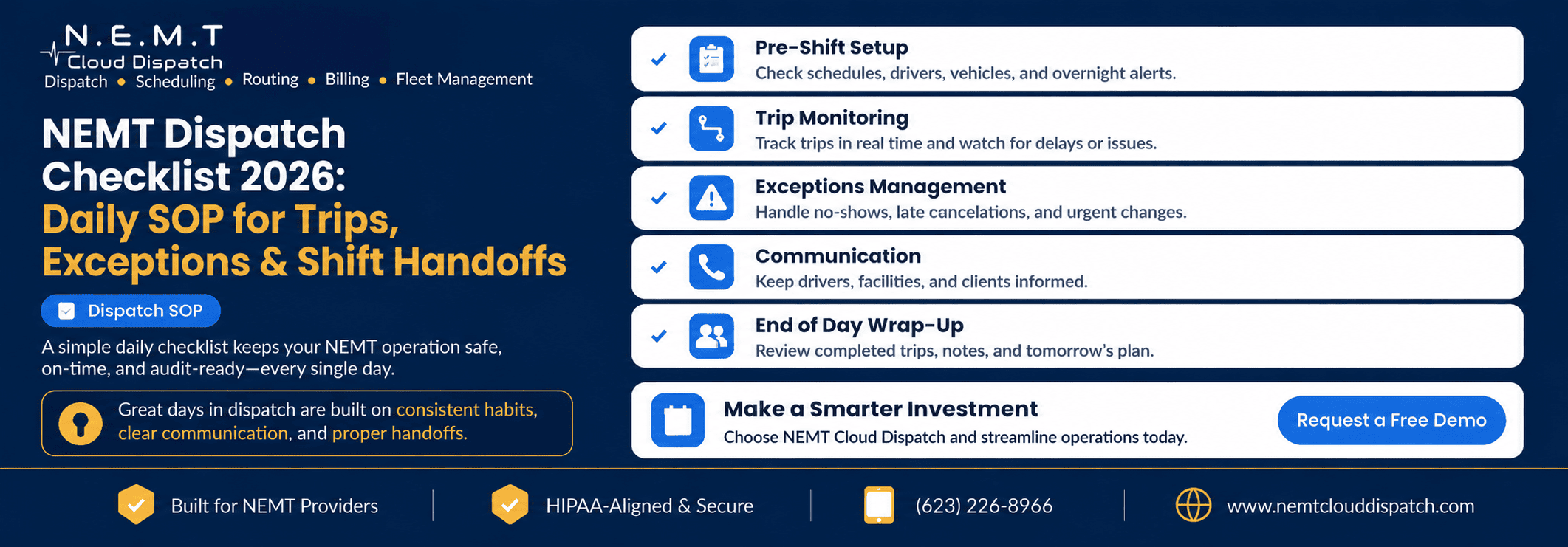
A clear NEMT dispatch checklist gives dispatchers a repeatable process for handling those changes without relying on memory, scattered text messages, or last-minute improvisation.
Quick answer: An NEMT dispatch checklist should cover pre-shift preparation, trip validation, driver and vehicle assignments, live trip monitoring, exception handling, shift handoffs, and end-of-day closeout. Every open issue should have a documented status, next action, responsible person, and escalation point.
This checklist is a practical operating framework, not a universal regulatory standard. Medicaid and NEMT requirements can vary by state, payer, broker, contract, and service type, so adapt the process to the rules that apply to your operation.
NEMT Dispatch Workflow at a Glance
A strong NEMT dispatch SOP can be organized into seven stages:
| Stage | Dispatcher Focus | Main Question |
|---|---|---|
| 1. Prepare | Drivers, vehicles, open trips | Is the operation ready for today’s schedule? |
| 2. Validate | Trip and rider requirements | Is every trip dispatch-ready? |
| 3. Assign | Driver and vehicle matching | Does the assignment fit the trip? |
| 4. Monitor | Live statuses and ETAs | Which trips need attention now? |
| 5. Recover | Exceptions and changes | How do we protect the affected trips? |
| 6. Handoff | Unresolved work | Does the next dispatcher know exactly what remains open? |
| 7. Close | Documentation and outcomes | Is each completed trip ready for downstream review? |
The goal is not to eliminate exceptions. NEMT operations will always have them.
The goal is to make the response predictable.
1. Pre-Shift NEMT Daily Dispatch Checklist
Before the first vehicle begins service, dispatch should have a clear view of the day’s operational capacity.
Confirm:
- Drivers scheduled for the shift are available.
- Required vehicle types are available and not on maintenance hold.
- Open issues from the previous shift have been reviewed.
- Standing and recurring trips are loaded correctly.
- Wheelchair, stretcher, escort, or other special-service requirements are visible.
- Open will-calls and unscheduled returns are identified.
- Broker or facility updates received since the previous shift have been reviewed.
- Trips with tight appointment windows or unusual requirements are flagged.
The pre-shift review should answer one practical question:
Where is today’s schedule most likely to fail if nothing changes?
Those are the trips dispatch should watch first.
2. Validate Every Trip Before Assignment
A trip should not become dispatch-ready merely because it appears on the schedule.
Before assigning it, validate the information the driver will actually need.
Check:
- rider/member identity;
- pickup location;
- destination;
- requested pickup or appointment time;
- authorization or broker trip reference where applicable;
- transportation/service level;
- mobility or equipment requirements;
- attendant or escort requirements;
- return-trip status;
- contact information;
- payer or broker;
- special instructions relevant to the trip.
A simple rule helps:
If the driver would need to call dispatch immediately to understand the trip, the trip probably was not fully validated.
3. Driver and Vehicle Assignment Checklist
A good assignment is more than finding the closest available driver.
Dispatch should match the trip with:
Driver availability. Can the driver complete the trip without jeopardizing the next assigned pickup?
Vehicle suitability. Does the vehicle meet the rider’s authorized transportation and capacity requirements?
Location. Is the driver’s current or expected position practical for the pickup?
Schedule compatibility. Does the assignment create unnecessary deadhead miles or schedule conflicts later in the route?
Known restrictions. Are there operational, qualification, vehicle, or contract considerations that affect the assignment?
NEMT Cloud Dispatch’s NEMT dispatching software keeps trip assignments, driver activity, GPS visibility, status changes, and same-day exceptions in one dispatch environment.
4. Live NEMT Dispatch Checklist
Once vehicles are moving, dispatch shifts from planning to active monitoring.
Your NEMT dispatch workflow should make every active trip’s status clear.
Typical statuses include:
- assigned;
- accepted;
- en route;
- arrived;
- rider onboard;
- dropped off;
- completed;
- cancelled;
- no-show.
Dispatch should pay the most attention to trips that stop progressing normally.
For example:
Assigned but not accepted: confirm that the driver received the assignment.
En route but ETA is deteriorating: determine whether reassignment or communication is needed.
Arrived but rider is unavailable: follow the applicable no-show/wait procedure.
Completed but missing required trip information: resolve the documentation gap before downstream billing or reconciliation.
Drivers using the NEMT Driver App can receive trip information, route changes, special-needs information, and communicate with dispatch while updating trip activity. NEMT Cloud Dispatch also supports GPS-aware pickup/drop-off records and proof-of-service workflows.
5. NEMT Exception Handling Playbook
Good dispatch operations are often defined by how consistently they manage exceptions.
A practical NEMT exception handling process should identify the problem, protect passenger safety, determine which trips are affected, choose a recovery action, communicate the update, document what happened, and escalate when the situation exceeds the dispatcher’s authority or available capacity.
| Exception | First Dispatcher Action | What to Document |
|---|---|---|
| Driver call-out | Identify affected trips and available recovery capacity | Reassignments and communications |
| Vehicle breakdown | Protect passenger safety and locate replacement capacity | Time, location, affected trips, actions taken |
| Late pickup risk | Check ETA and determine recovery options | Cause, revised ETA, notifications |
| Rider no-show | Follow payer/broker/company no-show procedure | Arrival time, contact attempts, outcome |
| Cancellation | Update trip and affected driver schedule | Source, time, reason if provided |
| Will-call ready | Confirm pickup details and available capacity | Request time, assignment, ETA |
| Facility delay | Update expected readiness and dependent trips | Facility communication and new ETA |
| Service mismatch | Stop inappropriate assignment and verify requirements | Conflict and resolution |
| Safety or medical emergency | Follow company emergency procedures and contact appropriate emergency resources | Incident details and escalation |
For a deeper treatment of unscheduled returns, link to How to Handle Will Calls in NEMT rather than duplicating the complete process here.
6. NEMT Shift Handoff Checklist
A dispatch handoff is not complete when one dispatcher says, “Everything is in the notes.”
A proper NEMT shift handoff checklist transfers ownership of unresolved work.
Review:
- Trips currently in progress.
- Late or at-risk pickups.
- Open return trips and will-calls.
- Unresolved rider or facility communication.
- Driver delays, call-outs, or restrictions.
- Vehicle problems or maintenance holds.
- Pending broker responses.
- Missing trip information or documentation.
- Incidents or complaints needing follow-up.
- The next action for every unresolved item.
- Who owns that action.
- When escalation is required.
The most useful handoff format is:
Current situation → next action → owner → deadline/escalation trigger
That is more actionable than a long narrative note.
7. End-of-Day Dispatch Closeout Checklist
A trip showing “completed” on the dispatch board does not necessarily mean the operational record is complete.
Before closing the day, review:
- Every scheduled trip has a final outcome.
- Cancelled and no-show trips are documented appropriately.
- Open will-calls have been resolved or handed off.
- Pickup and drop-off activity is recorded where required.
- Required mileage or trip data is present.
- Missing statuses have been investigated.
- Incident or exception notes are attached to the correct trip.
- Outstanding driver or vehicle issues are assigned for follow-up.
- Trips needing billing review are identified.
- Tomorrow’s high-risk recurring trips are visible to the next team.
This is where dispatch connects directly to billing.
NEMT Cloud Dispatch’s Billing & Claims workflow connects completed-trip information with claim and invoice processes so billing teams are not forced to rebuild every trip from disconnected records.
How NEMT Dispatch Software Supports the SOP
A written checklist defines what the team should do.
Software helps the team execute it consistently.
NEMT Cloud Dispatch brings together real-time trip assignment, driver tracking, status updates, route changes, driver communication, cancellations, no-shows, and other same-day exceptions. Its driver app connects field activity back to dispatch, while completed-trip information can continue into billing and reporting workflows.
That turns the NEMT dispatch workflow from a set of separate calls, spreadsheets, and notes into a connected operational process.
Managers can then use NEMT performance metrics to review whether the process is producing the desired results across on-time performance, trip completion, fleet utilization, and other operational measures.
One-Page NEMT Dispatch Checklist
Use this simplified version as the daily operating reminder.
Before the Shift
- Review prior-shift open items.
- Confirm drivers.
- Confirm vehicle availability.
- Review special-service trips.
- Identify will-calls and high-risk trips.
Before Dispatching a Trip
- Validate rider and locations.
- Confirm time window.
- Verify service requirements.
- Confirm authorization/broker information where applicable.
- Match the correct driver and vehicle.
During the Shift
- Monitor trip statuses.
- Watch late or stalled trips.
- Respond to exceptions.
- Communicate changes.
- Document decisions and outcomes.
Shift Handoff
- Transfer all active trips.
- Identify unresolved exceptions.
- Record the next action.
- Assign ownership.
- Identify the escalation deadline.
End of Day
- Confirm final trip outcomes.
- Review no-shows and cancellations.
- Resolve missing documentation.
- Flag billing or operational exceptions.
- Prepare important next-day items.
Frequently Asked Questions
What should an NEMT dispatch checklist include?
An NEMT dispatch checklist should cover pre-shift preparation, trip validation, driver and vehicle assignment, live trip monitoring, exception handling, shift handoffs, and end-of-day closeout. Each unresolved problem should have a clear next action and owner.
What is an NEMT dispatch SOP?
An NEMT dispatch SOP is the standardized procedure dispatchers follow to prepare, assign, monitor, recover, document, hand off, and close transportation trips consistently.
What should dispatch verify before assigning an NEMT trip?
Dispatch should verify the rider, pickup and destination, timing, transportation level, special requirements, return status, authorization or broker details where applicable, and the suitability of the assigned driver and vehicle.
What belongs in an NEMT shift handoff checklist?
The handoff should include active trips, late trips, open returns, unresolved exceptions, driver and vehicle issues, pending communications, missing documentation, the next required action, responsible person, and escalation point.
How should NEMT dispatchers handle exceptions?
Dispatchers should first address immediate passenger or operational safety concerns, identify affected trips, choose the appropriate recovery action, communicate with the necessary parties, document what happened, and escalate when the issue falls outside their authority or available resources.
How should NEMT dispatchers handle will-call trips?
Confirm that the rider is ready, validate the pickup and destination, review transportation requirements, identify suitable available capacity, provide a realistic ETA where possible, and document the assignment and communication according to the applicable broker or company process.
When is an NEMT trip ready to close?
A trip should have a final outcome and the operational information required by the provider’s applicable procedures. If important status, mileage, service, exception, or proof-of-service information is missing, the trip should be reviewed before downstream billing or reporting.
Can NEMT dispatch software replace an SOP?
No. Software supports the operating process; it does not replace the provider’s policies, training, payer requirements, or dispatcher judgment. The strongest operations combine a clear SOP with tools that make the procedure easier to execute consistently.
Turn Your Dispatch Checklist Into a Live Workflow
A checklist is valuable because it creates consistency.
The next step is making those checks visible inside the same system your dispatchers and drivers already use.
NEMT Cloud Dispatch connects schedules, live trip assignments, drivers, GPS activity, exceptions, communication, and completed-trip information in one platform.
Book a NEMT Cloud Dispatch demo and bring one of your real daily routes. See how your dispatch workflow could run from the first assignment through final trip closeout.
Operational note: This checklist is a general NEMT operating framework. Adapt it to your state requirements, Medicaid program, payer and broker contracts, service levels, company policies, and emergency procedures.