Non-emergency medical transportation (NEMT) is a small business problem that becomes a software problem the moment you grow past two or three vehicles. The phone rings. A broker like Modivcare or MTM sends 40 trips overnight. A driver no-shows. A dialysis patient needs to be there at 6 AM Tuesdays, Thursdays, and Saturdays, forever. You can run that on a whiteboard for a while. You cannot run it on a whiteboard at fifteen vehicles.
NEMT software exists to make that scale possible. This guide explains what NEMT software actually does, what features matter, and how to choose a platform that fits your operation — whether you run a solo operation with one wheelchair van or a multi-state fleet covering hundreds of trips a day.
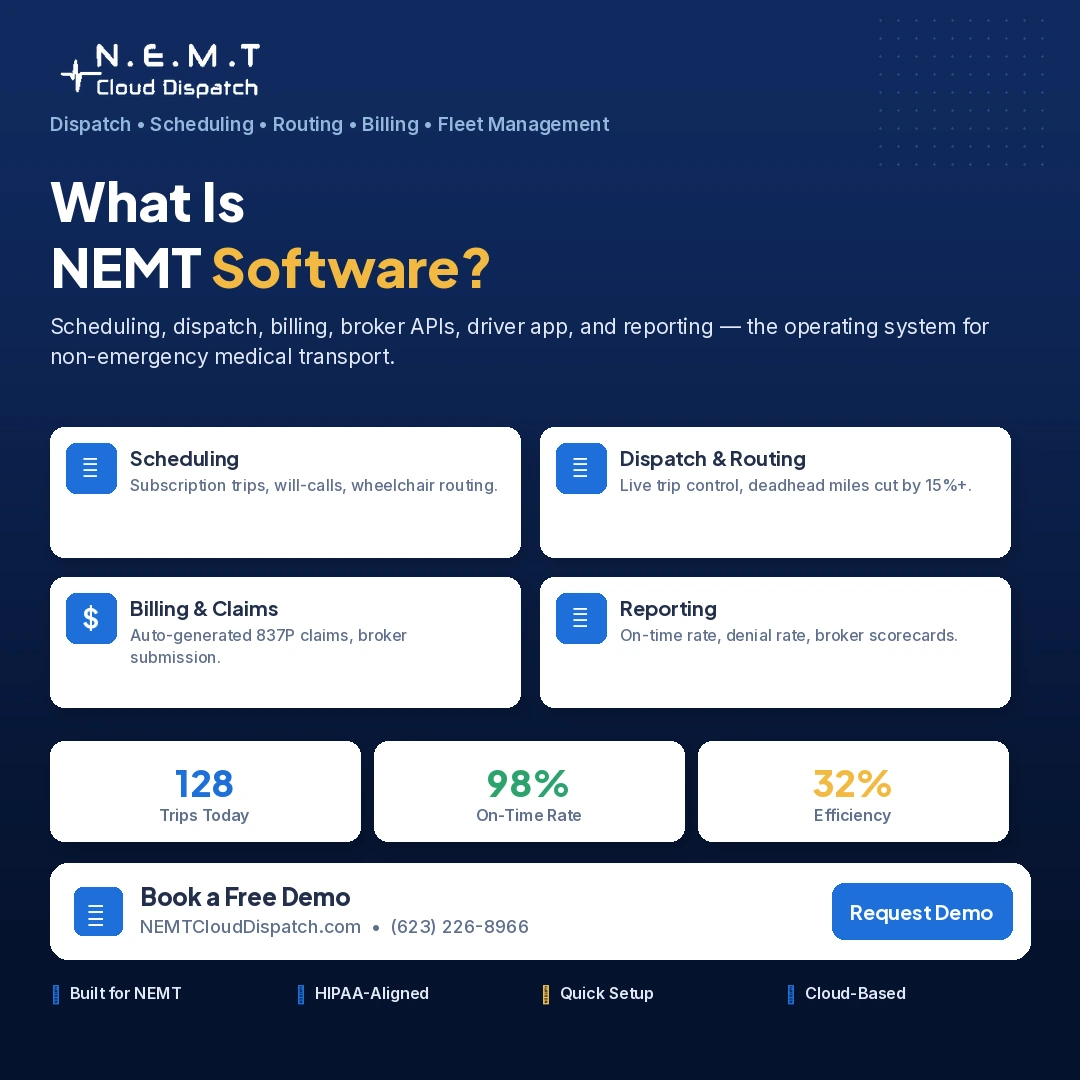
The 7 core functions every modern NEMT platform must handle.
What NEMT software does
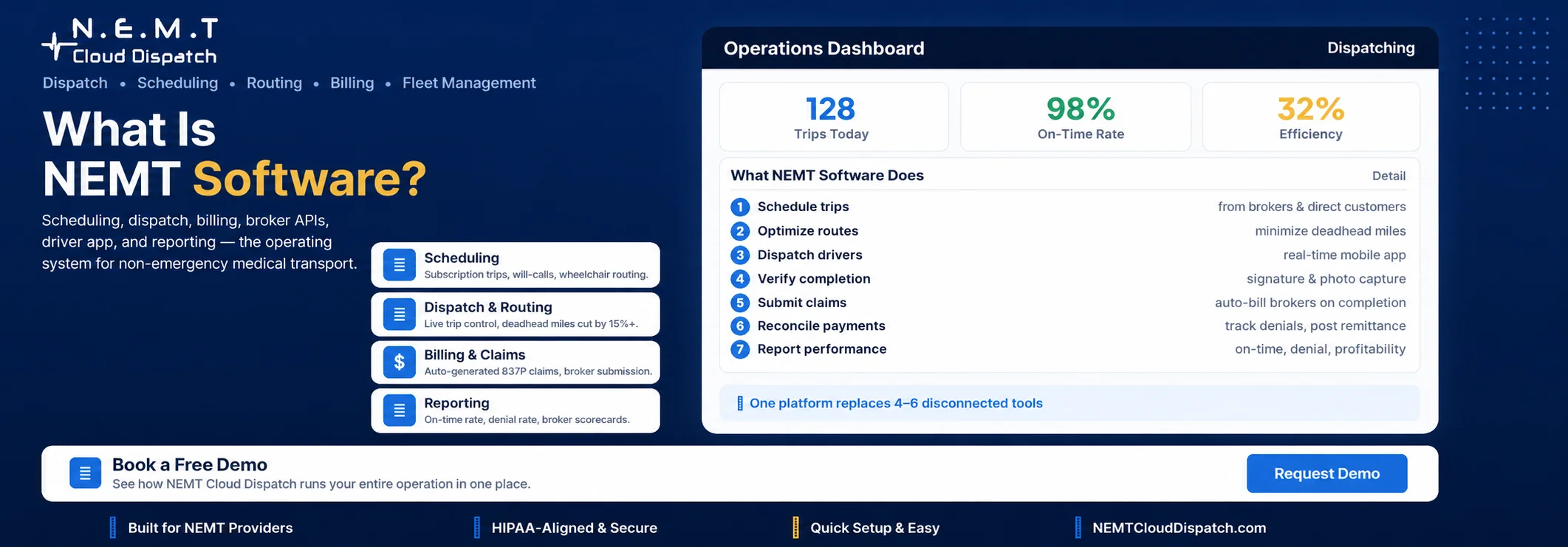
NEMT software is the operating system for a non-emergency medical transportation business. It runs the workflow from broker trip import through ride completion, claims submission, and payroll. A modern NEMT platform handles seven core functions:
- Trip scheduling — receiving trip requests from brokers, facilities, and direct customers, then assigning them to drivers and vehicles based on location, time, vehicle type, and driver qualifications
- Dispatch — real-time monitoring of active trips, handling cancellations, no-shows, and reassignments throughout the day
- Route optimization — sequencing multiple trips per driver to minimize deadhead miles and maximize completed trips per shift
- Driver applications — the mobile app drivers use to receive trips, navigate, capture signatures, and report status
- Broker integration — direct API connections to Medicaid transportation brokers so trips flow in automatically, eligibility is verified, and claims submit on completion
- Billing and claims — generating invoices, submitting claims to brokers and Medicaid, tracking denials, and reconciling payments
- Reporting — trip counts, on-time performance, driver hours, broker payouts, fleet utilization, and the metrics brokers and state auditors will ask for
The right NEMT platform consolidates all seven into one system. The wrong setup splits them across a scheduler, a separate dispatch tool, a third-party broker portal you check manually, a billing person who exports to Excel, and a driver app that doesn’t talk to anything else. Operators in the second setup spend half their day moving data between systems instead of moving patients.
Who uses NEMT software
NEMT software is built for three distinct user roles, and a good platform treats each role’s experience as a first-class problem rather than an afterthought:
- Owners and operators — the people running the business, looking at margins, growth, fleet utilization, and broker relationships. They need dashboards, reports, and confidence that the system is enforcing the rules without manual oversight.
- Dispatchers — the people running the day, watching trips fall behind, calling drivers about delays, rerouting around traffic, handling the inevitable chaos. They need real-time visibility and the ability to make changes fast.
- Drivers — the people in the vehicles, running the trips. They need a clean mobile experience that tells them where to go next, how to get there, and what to do when the rider isn’t ready.
A platform that’s great for owners but painful for dispatchers will be sabotaged by the dispatchers. A platform that drivers can’t use will see drivers improvising on paper. Look for a platform where all three roles get their work done well.
Why most operators outgrow generic dispatch tools
General-purpose dispatch software (the kind built for taxi fleets, delivery, or limousine companies) misses the things that make NEMT specifically hard. Medicaid transportation isn’t moving customers from A to B — it’s moving Medicaid members from A to B, billing the broker, documenting the trip in a way that survives a state audit, and integrating with seven different broker APIs that each work slightly differently.
Generic tools don’t know what Modivcare expects in a claim file. They don’t model wheelchair accessibility separately from ambulatory rides. They don’t handle escort policies, signature capture for trip verification, or no-show documentation in a way that survives a payment dispute. You can force a generic tool to do it, but you’ll spend more time fighting the software than running your business.
Purpose-built NEMT software is designed around the Medicaid transportation workflow from the start. Features like broker integration, claims-ready trip documentation, ADA-compliant vehicle handling, and trip verification are core to the platform rather than bolted on.
How to evaluate NEMT software
When you’re comparing platforms, four questions matter more than the feature checklists:
1. Does it integrate with the brokers you actually work with? If you have 80% of your trips coming through Modivcare, a platform that doesn’t have a Modivcare integration is automatically out. The same goes for MTM, Kaiser Permanente, Access2Care, VectorCare, Alivi, or HBSS.
2. Does the pricing scale with your business? Some platforms charge per trip, some per vehicle, some per user. Per-trip pricing punishes growth. Per-vehicle pricing is predictable. Per-user pricing penalizes adding dispatchers. Understand what you’ll actually pay at 5 vehicles, 15 vehicles, and 50 vehicles before signing anything.
3. Is the driver app actually used by drivers? Ask for a driver demo, not just an owner demo. Watch a real driver use it for 10 minutes. If they’re tapping through five screens to mark a trip complete or arguing with a navigation system that doesn’t know about the wheelchair entrance, your trips will be late.
4. Can it grow with you into new verticals? Many NEMT operators eventually add school transportation contracts or paratransit work. A platform built specifically for NEMT may not adapt. A platform built as a transportation OS that includes NEMT can grow with you.
What modern NEMT software costs
Pricing has consolidated in 2026 around per-vehicle monthly subscriptions, typically $50-200 per vehicle per month for full-featured platforms with broker integrations. Solo operators with one vehicle can find platforms starting around $49-59/month. Small fleets (2-5 vehicles) typically pay $100-300/month total. Growing fleets (6+ vehicles) pay $300-2,000/month depending on vehicle count and feature tier.
Platforms with transparent published pricing make it easier to compare options without sitting through five sales calls. NEMT Cloud Dispatch publishes complete pricing starting at $49.99/month for solo operators, $149.99/month for fleets up to 5 vehicles, and per-vehicle scaling beyond that. Other platforms quote on request, which usually means the price changes based on what they think you’ll pay.
Frequently asked questions
Do I really need NEMT software if I only have one or two vehicles?
Probably yes if you’re working with Medicaid brokers. Brokers expect API-level integration for trip assignments, status updates, and claims. A spreadsheet can technically track trips, but it can’t auto-import broker trips, auto-verify member eligibility, or auto-submit claims. The time savings show up immediately even at low vehicle counts.
What’s the difference between NEMT software and dispatch software?
Dispatch is one function inside NEMT software. NEMT software covers scheduling, dispatch, driver apps, broker integration, billing, claims, reporting, and HR — the full workflow. Dispatch software covers only the real-time trip management piece.
Can NEMT software handle private-pay rides alongside Medicaid?
Yes — most modern platforms support private-pay, facility-pay, and broker-pay rides on the same dispatch board. Billing splits automatically by payer type so you’re not manually sorting trips at the end of the month.
How long does NEMT software onboarding take?
Onboarding ranges from 1 day (solo operator with no broker integrations) to 4 weeks (multi-broker fleet with existing data to migrate). Watch for platforms that charge extra for onboarding — some include it free, others charge $500-5,000.
Which brokers do most NEMT software platforms integrate with?
Modivcare and MTM are the two most common. Kaiser Permanente, Access2Care, VectorCare, Alivi, and HBSS are the next tier. Smaller regional brokers are hit-or-miss — always confirm specifically before signing.