
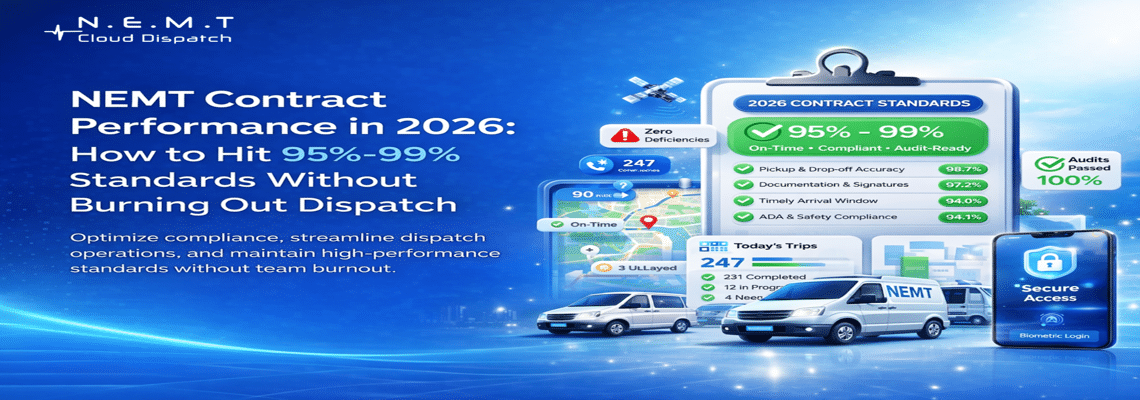
If your team is constantly chasing late vehicles, fixing avoidable trip errors, and responding to broker complaints, the problem is not just stress. It is NEMT contract performance. In 2026, providers are under more pressure to prove they can deliver reliable service at scale while keeping documentation clean, dispatch stable, and staff burnout under control. The good news is that 95%–99% service targets are achievable when you build the right systems around scheduling, routing, staffing, communication, and reporting. Recent industry guidance from HMA and NEMTAC explicitly says that holding most NEMT standards to 100% is unreasonable, while 95%–99% is often appropriate and attainable.
At NEMT Cloud Dispatch, we work with providers that need to improve dispatching, routing, fleet visibility, billing, broker support, facility coordination, and operational reporting without creating chaos for their teams. This guide explains how to improve NEMT contract performance with practical workflows, better visibility, and smarter use of automation so your company can meet demanding service levels without exhausting dispatch. You can explore our core platform on the NEMT Cloud Dispatch homepage and review our full feature set for NEMT operations.
Why contract performance matters more in 2026
State Medicaid contracts and broker programs are becoming more structured around measurable service outcomes. HMA’s 2025 NEMT contract toolkit found that state contracts increasingly address timeliness, missed trips, stranded members, urgent care trips, hospital discharges, complaint handling, reporting, and other operational KPIs. The same toolkit emphasizes that states should keep required metrics manageable, define them clearly, and avoid unrealistic 100% standards.
That shift matters because NEMT contract performance now affects much more than compliance. It influences broker confidence, trip volume, contract renewals, corrective action risk, payment confidence, and your reputation with facilities and payers. If your internal systems are weak, every added trip increases pressure. If your systems are strong, more volume can improve margins instead of destroying service quality.
The real target is reliability without dispatch burnout
Many operators make the mistake of pursuing performance improvement by asking dispatchers to work harder. That approach fails because manual work does not scale. A stronger strategy is to reduce friction across the entire workflow: intake, scheduling, routing, driver communication, shift planning, trip proof, exception handling, and billing.
This is where NEMT on-time performance becomes a useful signal. It reflects whether your scheduling logic, routing rules, staffing coverage, and live trip visibility are working together. HMA’s contract toolkit notes that timeliness is one of the most important but also one of the hardest metrics to manage because traffic, vehicle issues, and local conditions can affect results. That is exactly why teams need systems instead of guesswork.
What brokers and payers actually look for
Most providers know they are being measured, but many do not know how broad those measurements have become. Current NEMTAC standards work shows a clear push toward standardized reporting on service quality, efficiency, reliability, credentialing, complaint resolution, timely reimbursement, fraud prevention, and provider oversight. HMA’s toolkit also shows that contracts frequently evaluate timeliness, missed trips, member complaints, call responsiveness, trip types, and reporting consistency.
In practical terms, your company is usually being judged on these five areas:
- trip reliability
- documentation quality
- communication responsiveness
- complaint and exception control
- administrative reporting consistency
That is why NEMT performance metrics are no longer optional management tools. They are contract survival tools. When you measure the right things early, you can fix weak patterns before brokers escalate them into scorecard issues or corrective action.
The metrics every provider should track weekly
To improve NEMT contract performance, you need a weekly dashboard that is easy to read and hard to ignore. At NEMT Cloud Dispatch, we recommend a scorecard that gives owners, dispatchers, and operations managers the same version of the truth.
Start with these core NEMT performance metrics:
- pickup timeliness
- drop-off timeliness
- no-show rate
- same-day trip success
- will-call response time
- complaint rate
- driver assignment gaps
- cancellation cause categories
- claim rejection patterns
- vehicle downtime impact
If you want a deeper operations framework, our internal content on NEMT performance metrics every company should track is a strong companion resource because it connects operational KPIs to day-to-day management decisions.
A dashboard like this helps leaders spot patterns fast. For example, if late pickups spike during dialysis peaks, the issue may be route clustering or fleet availability. If same-day trips fail more often on weekends, the issue may be staffing design rather than dispatcher effort.
NEMT on-time performance: the metric everyone sees first
When brokers evaluate quality, NEMT on-time performance often becomes the headline number. It is easy to understand, easy to compare across providers, and closely tied to patient experience. That is why teams obsess over it. But it should never be viewed in isolation.
Strong NEMT on-time performance depends on:
- accurate appointment times
- realistic loading and unloading assumptions
- driver shift alignment
- live route updates
- fast handling of exceptions
- smart grouping of recurring trips
- proper vehicle-to-trip matching
This is one reason our NEMT Dispatching Software and NEMT Routing Software matter so much. Dispatchers need live visibility, automated updates, and route logic that supports decisions in real time instead of forcing them to rebuild the day by hand.
The goal is not just better NEMT on-time performance today. The goal is creating a repeatable operating model that keeps timeliness strong even as volume grows.
NEMT trip completion rate: where revenue and reputation meet
A company can look organized on paper and still fail where it counts. That failure often shows up in NEMT trip completion rate. If assigned rides are not completed cleanly and consistently, every other improvement loses value.
NEMT trip completion rate is affected by several hidden problems:
- weak intake verification
- unclear pickup instructions
- poor communication with facilities
- vehicle breakdowns
- driver reassignment delays
- bad contact information
- slow response to trip changes
This is why facility coordination matters so much. Our NEMT Facility Portal helps reduce confusion around requests, updates, and trip visibility, while our NEMT Driver App helps keep field execution aligned with dispatch. When intake, dispatch, and drivers share a connected workflow, NEMT trip completion rate improves because fewer trips fall through avoidable cracks.
NEMT broker performance standards are shaping the market
The pressure providers feel is not random. It is increasingly built into contracts and oversight models. HMA’s research shows that contracts vary widely, but commonly include provisions on timeliness, complaint handling, missed trips, urgent trips, discharge trips, reporting, and enforcement. NEMTAC’s broker standard overview also highlights provider credentialing, complaint resolution, trip assignment, fraud prevention, and timely reimbursement as core broker responsibilities.
That means NEMT broker performance standards are becoming more formal, more measurable, and more operationally demanding. Providers that still rely on scattered spreadsheets, verbal updates, and disconnected systems will struggle to adapt.
The smartest response is to translate NEMT broker performance standards into internal workflows:
- define each metric clearly
- set weekly review ownership
- build alerts for missing statuses
- flag recurring root causes
- link scorecard changes to corrective action
This is where our NEMT Brokerages Management Software supports providers that manage high-volume broker relationships. When broker-facing data, trip statuses, and billing workflows live in one system, teams can respond faster and with better documentation.
NEMT dispatch efficiency is the hidden driver of performance
If you want to improve contract results without burning out staff, focus on NEMT dispatch efficiency. Every late reassignment, missed note, repeated phone call, and manual schedule fix drains dispatcher energy. Over time, that creates fatigue, slower decisions, and more preventable errors.
Better NEMT dispatch efficiency usually comes from five changes:
- standardizing intake and trip rules
- automating repetitive status updates
- reducing duplicate communication
- improving route visibility
- reviewing exceptions by category instead of case by case
This is why modern software matters. NEMT Cloud Dispatch was built to make dispatching, routing, fleet management, billing, and broker support more efficient. Our pricing page and feature overview show how providers can move away from disconnected manual workflows toward one cloud-based operating system.
Improving NEMT dispatch efficiency is not about replacing dispatch judgment. It is about protecting that judgment by removing unnecessary friction.
How to hit 95%–99% without exhausting your team
The biggest lesson from current contract guidance is simple: achievable excellence beats unrealistic perfection. HMA’s toolkit clearly says most NEMT performance standards should not be held to 100% and that 95%–99% targets are often appropriate. That framing is valuable because it gives providers room to build resilient systems instead of fear-driven ones.
Here is the operating model we recommend at NEMT Cloud Dispatch to improve NEMT contract performance sustainably:
1. Build a weekly scorecard, not a monthly surprise
Use NEMT performance metrics to review operational health every week. Weekly visibility helps you catch drift before it becomes a broker issue.
2. Manage the causes of lateness, not just the symptom
Track route congestion, discharge delays, bad appointment data, and late vehicle swaps. Better NEMT on-time performance comes from fixing patterns, not blaming dispatchers.
3. Protect assigned trips from preventable failure
Use confirmation steps, better trip notes, and real-time driver status updates to raise NEMT trip completion rate.
4. Translate contracts into workflows
Turn NEMT broker performance standards into internal SOPs, ownership rules, and live alerts so staff do not need to rely on memory.
5. Remove low-value manual work
Invest in automation that improves NEMT dispatch efficiency and gives your team more time for exceptions, customer support, and quality control.
The role of software in better contract results
Technology alone does not fix operations, but the right platform makes disciplined operations much easier. Providers need one place to manage trips, route logic, driver communication, fleet visibility, invoices, and broker workflows. Without that, teams end up doing more manual work as volume increases.
NEMT Cloud Dispatch helps providers strengthen NEMT contract performance through connected tools for dispatching, routing, fleet management, billing, driver communication, HR tracking, and broker support. Those connected workflows make it easier to improve NEMT on-time performance, watch NEMT performance metrics, support NEMT trip completion rate, satisfy NEMT broker performance standards, and improve NEMT dispatch efficiency in one operating environment.
Common mistakes that quietly hurt performance
Many providers do not fail because they lack effort. They fail because their systems create avoidable instability.
The most common issues we see are:
- overbooking peak windows without route buffers
- assigning dispatchers too many manual tasks
- tracking results too late to correct them
- using multiple disconnected tools for the same trip
- treating contract rules as billing issues instead of operations issues
- failing to train staff on exception categories and escalation paths
Each of these weakens NEMT contract performance over time. More importantly, each of these can usually be fixed with better process design and stronger use of software.
Final thoughts
In 2026, strong providers will not win by promising perfection. They will win by building reliable systems that consistently hit realistic service goals, protect staff capacity, and create trust with brokers, payers, and facilities. That is the path to better NEMT contract performance.
If your team wants a simpler way to improve scheduling, routing, fleet visibility, billing, broker workflows, and dispatch operations without increasing stress, NEMT Cloud Dispatch can help. Request a Demo to see how our platform helps providers improve performance, reduce manual work, and scale with confidence.
Frequently Asked Questions (FAQs)
NEMT contract performance is a provider’s ability to meet the service, reporting, responsiveness, and quality standards defined by Medicaid contracts, brokers, health plans, or facility partners. Current industry guidance emphasizes measurable standards such as timeliness, missed trips, complaints, and reporting quality.
A good NEMT on-time performance rate depends on the contract definition, but current HMA guidance indicates that many performance standards are best set in the 95%–99% range instead of 100%.
The most important NEMT performance metrics usually include pickup timeliness, trip completion, complaint trends, response time, denial patterns, and exception rates. Standardization work from NEMTAC also points toward service quality, efficiency, and reliability as core measurement areas.
NEMT trip completion rate matters because it reflects whether scheduled rides actually become delivered services. It affects revenue, broker confidence, patient experience, and operational credibility.
NEMT broker performance standards are the expectations brokers use to evaluate service quality, provider accountability, complaint handling, trip assignment, documentation, and reporting. NEMTAC’s broker standard overview highlights these areas as central to broker operations.
The best way to improve NEMT dispatch efficiency is to reduce repetitive manual work, standardize workflows, improve real-time visibility, and automate updates where possible. That gives dispatchers more time to manage true exceptions instead of routine friction.