
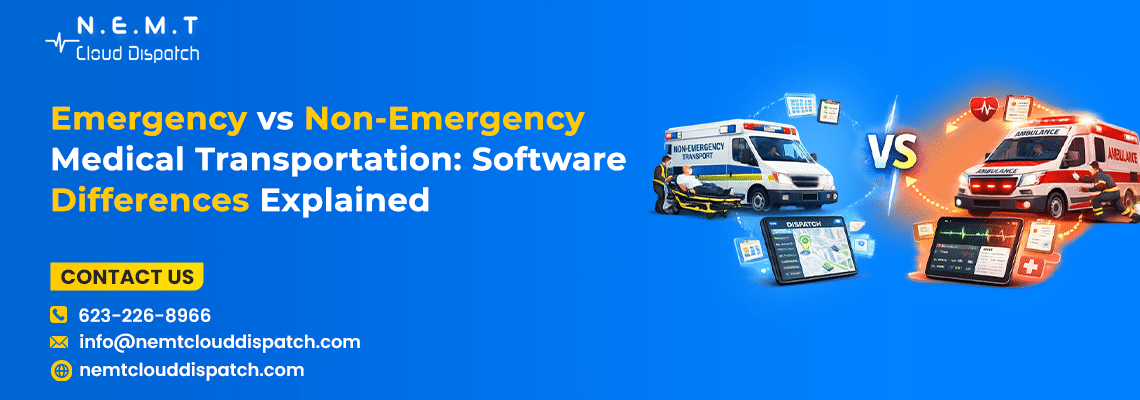
Healthcare transportation plays a vital role in patient care. However, not all medical transport operates the same way. Understanding the emergency vs non emergency medical transportation difference is essential for providers, brokers, and healthcare organizations choosing the right technology.
At first glance, both services move patients from one place to another. Yet, their urgency, workflows, compliance rules, and dispatch methods differ significantly. Therefore, the software supporting them must also differ.
In this guide, we clearly explain the operational and technical differences between EMS and NEMT systems. Additionally, we show why specialized NEMT platforms deliver better efficiency for scheduled patient transport providers.
Understanding Emergency vs Non-Emergency Medical Transportation
The key emergency vs non emergency medical transportation distinction lies in patient condition and urgency level.
- Emergency Medical Services (EMS): Immediate transport for critical or life-threatening situations
- Non-Emergency Medical Transportation (NEMT): Planned transport for stable patients
Because urgency levels differ, workflows and software logic also differ. This core EMS vs NEMT difference shapes how dispatch, routing, billing, and compliance systems operate.
Furthermore, the emergency medical transport vs NEMT contrast affects staffing models, fleet use, and scheduling complexity. Consequently, any accurate medical transportation software comparison must evaluate these factors.
Operational Differences in Emergency vs Non Emergency Medical Transportation
Response Urgency vs Scheduling in NEMT Dispatch Software
Emergency systems prioritize speed above all else. In contrast, NEMT operations prioritize planning and efficiency.
For example, EMS dispatch software focuses on:
- Closest-unit selection
- Rapid incident response
- Real-time coordination
Meanwhile, non emergency medical transportation software focuses on:
- Trip scheduling
- Route planning
- Recurring rides
- Broker coordination
Therefore, this operational contrast represents a major EMS vs NEMT difference.
Additionally, it explains why EMS tools cannot manage high-volume scheduled transport effectively. As a result, any medical transportation software comparison highlights scheduling as a defining NEMT requirement.
Incident Management vs Trip Management
Another important emergency medical transport vs NEMT distinction involves workload patterns.
EMS teams handle unpredictable emergencies. However, NEMT providers manage large numbers of planned trips daily.
For instance, NEMT scheduling includes:
- Dialysis recurring trips
- Appointment time windows
- Facility pickups
- Shared rides
Because of this complexity, advanced NEMT dispatch software uses automation and optimization engines unavailable in EMS tools.
Therefore, trip management becomes another critical EMS vs NEMT difference.
Compliance and Documentation Differences in Emergency vs Non Emergency Medical Transportation
Clinical Care vs Transport Verification
EMS documentation focuses on patient treatment. Conversely, NEMT documentation focuses on transport validation.
For that reason, non emergency medical transportation software typically includes:
- Electronic trip verification
- Driver credential tracking
- Vehicle compliance monitoring
- Broker authorization validation
Since compliance requirements vary by state, refer to your specific state’s Medicaid transportation policy, which is often guided by federal frameworks detailed in the CMS regulations.
Routing and Fleet Optimization in Emergency vs Non Emergency Medical Transportation
Fastest Route vs Most Efficient Route
Emergency routing aims for the fastest arrival time. In contrast, NEMT routing aims for efficiency and cost control.
Modern systems like NEMT routing software enable:
- Multi-stop optimization
- Driver workload balancing
- GPS‑guided routes
Paired with fleet visibility and management tools, these features help NEMT providers save fuel, reduce overtime, and improve on‑time performance.
The principles of route planning and optimization are also explored in the transport research published by the Transportation Research journal.
Billing and Payment Structures in Non Emergency Medical Transportation
Insurance Claims vs Broker Billing
EMS billing relies on medical codes and insurance claims. However, NEMT billing relies on trip verification and broker contracts.
Therefore, non emergency medical transportation software automates:
- Medicaid billing
- Broker invoicing
- Mileage validation
- Trip cost tracking
Automated billing reduces errors and claim denials, aligning with standards outlined in the
CMS Medicare billing rules where applicable.
Integration Ecosystems
EMS systems connect to hospitals and emergency networks. Meanwhile, NEMT systems connect to brokers and healthcare facilities.
For example, leading NEMT dispatch software integrates with:
- Medicaid brokers
- Healthcare providers
- Eligibility systems
- Scheduling portals
Therefore, platform integration represents another core EMS vs NEMT difference.
Additionally, this ecosystem structure defines modern non emergency medical transportation software architecture.
Why Generic Transport or EMS Software Fails in NEMT
Many providers attempt to adapt logistics or EMS tools for NEMT use. However, this approach creates inefficiencies.
Generic platforms typically lack:
- Recurring scheduling
- Broker workflows
- Trip eligibility checks
- Medicaid billing logic
Because emergency medical transport vs NEMT operations differ fundamentally, only specialized non emergency medical transportation software can support scalable NEMT operations.
Therefore, this mismatch consistently appears in any medical transportation software comparison.
Capabilities Unique to NEMT Software
Purpose-built NEMT dispatch software includes features rarely found in EMS platforms:
- Automated route optimization
- Recurring ride management
- Broker integration
- Driver mobile apps
- Real-time trip tracking
- Compliance dashboards
These capabilities directly address each EMS vs NEMT difference discussed above.
Furthermore, they dominate modern medical transportation software comparison evaluations.
Choosing the Right Platform for Your Business in Emergency vs Non Emergency Medical Transportation
If your organization handles scheduled patient transport, EMS software will create friction and inefficiency.
Because the emergency medical transport vs NEMT workflow gap affects:
- Dispatch productivity
- Fleet utilization
- Billing accuracy
- Broker relationships
Selecting advanced non emergency medical transportation software ensures operational efficiency and regulatory compliance.
Therefore, choosing the correct platform is essential for growth.
How NEMT Cloud Dispatch Supports NEMT Providers
As a specialized provider, NEMT Cloud Dispatch delivers advanced NEMT dispatch software designed specifically for NEMT operations.
The platform provides:
- Intelligent scheduling
- Automated routing
- Fleet management
- Broker integration
- Billing automation
- Real-time visibility
Because it is purpose-built, it directly addresses the emergency vs non emergency medical transportation divide.
Additionally, its architecture aligns with every major EMS vs NEMT difference identified in this article.
The Future of Medical Transportation Software
Healthcare transport technology continues evolving. However, the emergency medical transport vs NEMT divide will remain fundamental.
Future non emergency medical transportation software trends include:
- AI route optimization
- Predictive scheduling
- Broker API ecosystems
- Compliance automation
- Patient engagement tools
Therefore, future medical transportation software comparison frameworks will increasingly emphasize NEMT-specific intelligence.
Conclusion: The Right Software Drives NEMT Success
Understanding the emergency vs non emergency medical transportation landscape is essential when choosing transportation technology. EMS and NEMT operations differ in urgency, scheduling, compliance, routing, and billing. Consequently, their software must also differ.
Specialized non emergency medical transportation software delivers the automation, optimization, and broker connectivity required for efficient NEMT operations. As explained throughout this guide, every EMS vs NEMT difference reinforces the need for purpose-built platforms rather than adapted EMS tools.
If your organization provides scheduled patient transport, modern NEMT dispatch software can transform efficiency, reduce costs, and improve reliability.
Request a Demo today to see how NEMT Cloud Dispatch can optimize your operations and help your transportation business scale with confidence.
Frequently Asked Questions (FAQs)
Emergency transport handles life-threatening situations, while non-emergency transport serves stable patients with scheduled medical trips. Therefore, their workflows and software needs differ.
Because EMS tools lack scheduling, routing, and broker features, providers need dedicated non emergency medical transportation software to manage trips efficiently.
The EMS vs NEMT difference appears in dispatch logic, routing, billing, and compliance. EMS focuses on speed, whereas NEMT focuses on planning and efficiency.
NEMT dispatch software automates trip scheduling, route optimization, driver assignment, and real-time tracking, which improves efficiency and reduces costs.
A medical transportation software comparison should evaluate scheduling, routing, billing, broker integration, and compliance features.
In emergency medical transport vs NEMT, EMS uses the fastest route, while NEMT uses optimized multi-stop routes to save time and fuel.